
World War I (1914-1918) Treaties
Treaty of Versailles
This treaty was signed by Allied Nations and Germany on the 28th of June of 1919 which also as seen as formally ending WW 1 in addition to requiring Germany to pay financial reparations, removal of weapons and power of overseas territories/colonies. This also meant giving up around 10% of pre-war territories in Europe.

Treaty of Saint-Germain-en-Laye
This treaty was signed by both Austrian representatives and Allied Powers on the 10th of September on 1919 which not only concluded the end of WW1. This treaty also served as a formal ending of the Habsburg Empire (which is the royal German family and one of the dynasties between 15th to 20th century) as well as bringing the recognition the independence of Czechoslovakia, Poland, Hungry, Kingdom of the Serbs, Croats, Slovenes (Yugoslavia) and giving up the power over eastern Galicia, Trento, southern Tirol, Trieste and finally Istria. The disposition of southern Carinthia was determined by votes (Plebiscites which is the vote of members of an electorate on important issues) which was given to Austria and Sopron was given to Hungary. The treaty also put the Republic of Austria in a position to accept the independence of over 60% of its previous territory as briefly described in the examples above.
A few months later, the Treaty of Neuilly was signed by Bulgaria which meant losing power over territory to the new Yugoslavia and entry to the Aegean Sea.
On June 4, 1920, the Treaty of Trianon was signed with the main beneficiaries being Kingdom of Romania, Czechoslovak Republic, the Kingdom of Serbs, Croats and Slovenes, and the First Austrian Republic. One of the main objectives of the treaty was the belief of “self-determination of peoples” and its aim to give the non-Hungarians their own national states as well as the fact that Hungarians had to pay reparations to its neighbors.
The Treaty of Sevres, signed on August 1920 between Allies and the late Ottoman Empire.
This was a pact between the Allies and the Ottoman Empire, taking apart the Empire and forcing it to give up its territories in North Africa and the Middle East. It also introduced the recognition of independent areas for Armenia, Kurdistan, and Thracian Greece.
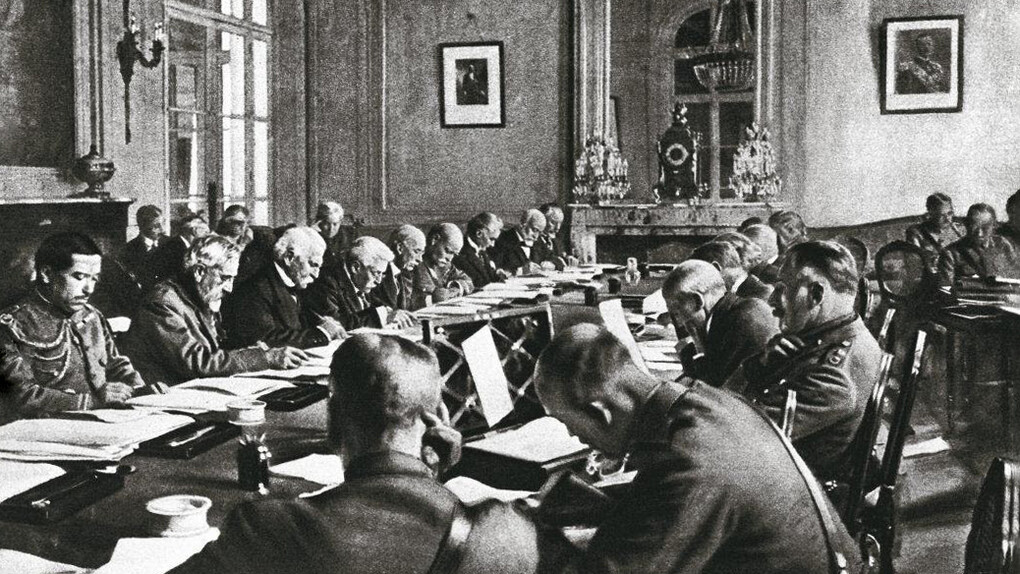
The Treaty of Sèvres
The Treaty of Lausanne, is known to replace Sevres (since that treaty was trying to break the Ottoman Empire apart) was signed negotiated with Turkey and was the last treaty to conclude WWI. This was between Turkey on one side and by Britain, France, Italy, Japan, Greece, Romania, and the Kingdom of Serbs, Croats, and Slovenes on the other. By signing this treaty it meant that Turkey was internationally recognized and maintained its territory while also giving up claims to the former Ottoman lands in Middle East and North Africa.
World War II (1939 – 1945) Treaties
Molotov-Ribbentrip Pact (The unofficial name of this agreement has also been called Hitler-Stalin or Nazi-Soviet Pact) A pact between Nazi Germany and the Soviet Union (signed in Moscow on 23 August 1939) with the understanding that divided Central and Eastern Europe between the two (and not attack one another). The one who signed it are as follows: German Foreign Minister Joachim von Ribbentrop and Vyacheslav Molotov the Soviet Foreign Minister.
Another (secret) addendum was amalgamated into the treaty – known as the German-Soviet Boundary and Friendship Treaty – a month later – after jointly taking over sovereign Poland.
Sykes Picot Agreement
In May 1916, a secret agreement was made between Great Britain and France, with approval from Russia and Italy, to state their ‘spheres of influence’ and control in the Middle East after the downfall of the Ottoman Empire. This is particularly important since it disregards the independence of the Arab population and has had continuing implications for regional politics.

Yalta Conference
This conference was held from February 4 to 11 in 1945 which took place between the “Big Three” Allied Leaders who are: President Franklin D. Roosevelt, Prime Minister Winston Churchill, and Premier Joseph Stalin. The main goal of this meeting was to shape the post-war world order and defeat Nazi Germany. The main key agreements were as follows
1. To divide Germany into four occupation zones where each one was controlled by one of the allied powers.
2. They agreed to establish United Nations to promote global peace (hmm ok)
3. Eastern Europe: Stalin had promised free elections in Eastern European countries which were liberated by the Soviet Union
4. Stalin agreed Soviet Union would enter the war against Japan within three months of Germany’s surrender. But in exchange, Allied leaders agreed to provide the Soviet Union with ‘territorial concessions’
5. Although this next point came up as a major issue during the cold war, the last key agreement was to agree on Poland’s future borders and government. (Britain and USA were worried Poland would be controlled by the USSR whereas Stalin wanted a friendly pro-soviet government since the Soviet Union had been invaded through Poland twice by Germany in addition to wanting to keep the eastern part of Poland (which USSR had taken in 1939)
Potsdam Conference
This meeting was between the Allied powers in July 17 to August 2 in 1945. The meeting took place between Joseph Stalin, Harry Truman, Winston Churchill (Clement Attlee later replaced him) where the leading Allies discussed the post-war order in Europe and Asia and countering the effects of the war. The main decisions were as follows:
1. Divide Germany into four occupied zones
2. Eastern border of German to be shifted west to the Oder-neisseline.
3. Recognition of Soviet-backed group as the legitimate government of Poland.
4. Remove Nazi influence and weapons in Germany.
5. Move millions of Germans out of countries such as Poland and Czechoslovakia.
6. Demand the surrender of Japan.

Japanese Surrender – Instrument of Surrender
This was the official document that concluded World War II which Japan signed on September 2nd in 1945. The surrender came right the atomic bombings of Hiroshima and Nagasaki and the Soviet Union declaring war on Japan. By signing this document Japan agreed to stop fighting, accept the terms set by the Allies (mainly U.S.) and disarm.
Interesting Information:
40 maps that explain World War I | vox.com
The Complete History of the Second World War | World War II Documentary | Part 1
The Complete History of the Second World War | World War II Documentary | Part 2
The World War II battle against STDs
 Hiba's curmudgeonly musings about books, politics & other trifles.