
- The Islamic State has accepted the allegiance of Boko Haram.
- Nigeria has reportedly recaptured 36 towns from the terror group.
- Chadian troops fighting Boko Haram have redeployedfurther south, a possible sign of a new offensive in the works.
- As a response to Chad’s involvement in regional military efforts against Boko Haram, the group is carrying outethnic targeting of Arabs it accuses of supporting Chad.
- Nigeria has also brought in mercenaries to help it in its fight.
- Rockets were fired at a UN base in northern Mali last weekend, killing at least three, including a peacekeeper.
- The International Criminal Court has combined the trials of former Ivory Coast president Laurent Gbagbo and his ally Charles Ble Goude because the two cases, both over post-election violence, are so similar.
- A court in the Ivory Coast jailed Gbagbo’s wife, the former first lady Simone Gbagbo, for twenty years over her role in the same violence.
- A downward spiral in Libya is an opportunity for the Islamic State.
- The dangerous lives of Palestinian fisherman.Gaza’s parkour team gives a tour of life on the strip.Oman jailedblogger and activist Saeed Jaddad for three years for “undermining the status and prestige of the state.”
- A new report on the impact of violence on Syria details plummeting life expectancy, extreme poverty and 58% unemployment.
- 21 aid organizations released a report strongly criticizingthe UN Security Council for failing to better address the crisis in Syria.
- A Syrian doctor writes about the horrors of barrel bombing.
- The US ambassador-at-large for war crimes has said that the case against Bashar al-Assad is stronger than were the cases against Serbia’s Slobodan Milosevic and Liberia’s Charles Taylor.
- How did Mohammed Emwazi become “Jihadi John”?
- Brookings examines the growth and development of the ideology of the Islamic State.
- A small number of Americans, including some veterans, have gone abroad to join the fight against the Islamic State.
- The Islamic State has attacked and done damage to the 2700-year-old city of Khorsabad.
- Iraqi security forces and Shi’ite militias continue to battlethe Islamic State for the Iraqi city of Tikrit.
- Iraqi military units are under investigation for their own acts of torture, brutality and extrajudicial executions in their fight against the Islamic State.
- A warning letter to Iranian leaders, signed by 47 Senate Republicans, has caused a serious stir.
- A Taliban ambush killed seven Afghan policemen in Kunduz.
- In a move toward reconciliation, Sri Lanka granted bailto Tamil activist Jeyakumari Balendran, held this past year without charge.
- The primary suspect arrested in Boris Nemtsov’s murder has withdrawn his confession, saying he was coerced into it.
- A new report outlines Russia’s involvement in the war in Ukraine over the past year.
- Accounts provided by villagers in Ukraine have offered the greatest detail so far in tying the missile that took down MH17 to rebel-held territory.
- The US will provide Ukraine with an additional $75m in “nonlethal aid.”
- North Korea test-fired seven surface-to-air missiles.
- A report released today outlines mistakes made in a January police raid in the Philippines that left 44 officers dead and endangered a prospective peace deal.
- The US has asked Vietnam to stop allowing Russia to refuel at a former US base in the country.
- As part of a move to sanction seven law enforcement and military officials in Venezuela, President Obama declaredVenezuela a national security threat.
- Colombia will halt bombing raids against FARC rebels for one month.
- A leak investigation into Marine Gen. James Cartwright has stalled out of concern that it could force the US to confirm a joint operation with Israel carried out against Iran.
- The UN special rapporteur on torture has accused the United States of stalling his requests to visit American prisons and to meet with detainees at Guantánamo.
- The CIA reportedly helped the Justice Dept in its efforts to scan cellphone data en masse.
- A British Parliamentary report has called the legal framework for surveillance “unnecessarily complicated,” saying it should be governed under one law.
- Wikimedia and others are suing the NSA over privacy violations.
Last Month in War (2nd to 27th February 2015)
Due to the lack of posts on the usual political updates. Here is an accumulation of events that took place last month. An update for this week will be up shortly.
February 23rd – 27th 2015
- The regionalization of the war against Boko Haram creates both new opportunities for victory over the terror group and new risks.
- American trainers prepare the Chadian army for war with Boko Haram.
- Bombs in the Nigerian city of Jos and the town of Biu killed 34 people.
- Further violence in the Central African Republic has forced the internal displacement of 30,000 people already this year, and another 20,000 have fled over the border into the Democratic Republic of Congo.
- The Congolese government launched strikes against the Democratic Forces for the Liberation of Rwanda, a Rwandan Hutu rebel group involved in many years of violence in eastern Congo.
- The International Criminal Court upheld the war crimes acquittal of former Congolese militia leader Matthieu Ngudjolo.
- The South African intelligence service used an agent with links to Russia to spy on its own government.
- Survivors of the Islamic State’s raid on a compound in Sirte, Libya, where they abducted Egyptian Copts whom they later beheaded, tell their story.
- Egyptian President Abdel Fattah Al-Sisi signed into law a new anti-terrorism actthat gives the government greater powers against individuals and groups it deems a threat to national security.
- Banksy has reappeared in Gaza.
- A watchdog group says that Israeli settlements in the occupied West Bank rose by forty percent last year.
- Yemen’s ousted president has withdrawn his resignation after either escaping or being released from rebel captivity.
- The Islamic State fighter who committed the serial on-camera beheadings of hostages, known to the Western public as Jihadi John, has been named as Kuwaiti-born Londoner Mohammed Emwazi.
- As the Islamic State retreated from a Kurdish counter-offensive in northeast Syria, they took 90 Assyrian Christians hostage.
- Crowdfunding attempts to raise an army to combat the Islamic State.
- In Mosul, the Islamic State ransacked the library and burned 100,000 books and manuscripts. They also videotaped themselves taking sledgehammers and power tools to the ancient artifacts in the museum and at an archaeological site.
- In Tikrit, the group took hostage 100 Iraqi men and boys, many of whom have family members fighting the Islamic State.
- Bombings in Baghdad killed 37 on Tuesday.
- Reuters details the ways in which the Iraqi government, Iran and Shi’ite paramilitary groups collaborate inside Iraq.
- A UN report details the “regular and prevalent” torture of detainees by Afghan security forces.
- The Afghan Taliban has re-established its offices in Doha and is starting talks with Kabul.
- The US is considering extending its mission in Kandahar.
- Avijit Roy, a well-known blogger and writer in Bangladesh who spoke out against violent fundamentalism, was killed by unidentified assailants this morning (February 26th) in Dhaka.
- The loss of the Ukrainian town of Debaltseve to the Russian-backed rebels and the subsequent rebel attack on Mariupol puts Ukraine in a difficult positionbetween the Western peace agreement and the reality of further land grabs.
- A Kremlin memo published in Russian newspaper Novaya Gazeta shows that Russia planned the annexation of Crimea before the collapse of the Ukrainian government.
- A year’s worth of war has ravaged Ukraine’s Donetsk Airport. More from Reuters.
- British military personnel will train and advise the Ukrainian military.
- Violent clashes broke out between police and anti-government protesters in Athens.
- Two former detainees of a police “black site” in Chicago, as first reported last week by The Guardian, speak out to The Intercept.
- The recent reporting on torture committed by the Chicago PD and further torture committed by former Chicago detective Richard Zuley at Guantánamo, is important to read in the context of the reporting done by John Conroy in the 1980s. Conroy’s work uncovering police torture and forced confessions in Chicagoremains some of the best journalism I’ve ever read.
- The FBI arrested three Brooklyn men this week who were allegedly planning to travel to Syria to join the Islamic State, and short of that, conduct attacks on US soil. The New Yorker explores whether the FBI encouraged the would-be terrorists prior to arresting them.
- A Minnesota teen pleaded guilty to a count of conspiracy after being stopped at the airport attempting to travel to join the Islamic State.
- Six students who disappeared from Montreal are believed to have travelled abroad to join the Islamic State, bringing suspicion down upon a Montreal Islamic teacher.
- After last week’s revelations that the NSA and GCHQ had hacked Gemalto, the world’s biggest manufacturer of cell phone SIM cards, the company is busy saying the breach really wasn’t so bad.
- VICE News received, after submitted a FOIA request, internal analysis done by the Defense Intelligence Agency regarding the impact of the Snowden leaks on national security – but they were all but entirely redacted.
- Laura Poitras’ documentary of the Snowden leaks, Citizenfour, won an Academy Award last weekend. Laura Poitras, Glenn Greenwald and Edward Snowden did a Reddit AMA.
- CIA Director John Brennan is planning a broad expansion of the agency’s cyber capabilities, a part of his bigger restructuring plans that would be aimed at breaking down the walls between operations and analysis.
- Meanwhile, the intelligence community is raising the level of concern over a Russian cyber threat, with Director of National Intelligence James Clapper saying “the Russian cyber threat is more severe than we had previously assessed.”
- Reuters investigates the impacts of the Pentagon bureaucracy’s bad payroll bookkeeping.
- While the government still refuses to release its photographic evidence of torture,soldiers’ own photographs of detainee abuse are coming to light.
- After the Pentagon ordered judges in the 9/11 trials to move to Guantánamo for the duration of the case, a judge abated the pre-trial death penalty hearing for Khalid Sheikh Muhammed, saying the relocation order brought up concerns of “Unlawful Influence by creating the appearance of improper pressure on the military judge to adjust the pace of the litigation.”
- The Periodic Review Board approved Egyptian Guantánamo detainee Tariq el-Sawah for release.
- At the Brooklyn trial of Al Qaeda suspect Abid Naseer, MI-5 agents wore wigs and makeup in order to testify in court.
- A Saudi man, Khalid al-Fawwaz, was found guilty in a New York court of four counts of conspiracy for plotting the 1998 African embassy bombings.
- An excerpt up at The Guardian from a new book about drone warfare.
- The number of women set to attend Army Ranger School in April is up to six.
February 16th- 20th 2015
- The Islamic State beheaded 21 Egyptian Copts in Libya, using their footage in yet another propaganda video.
- Libya is asking the UN to lift an arms embargo to allow it to combat the terror group.
- Mali and the Tuareg-led rebels agreed to a cease-fire on Thursday so that another round of UN negotiations could proceed.
- Boko Haram lost ground to a major push by the Chadian army into northern Nigeria and the Nigerian military says it killed 300 Boko Haram fighters in an offensive on Wednesday.
- Boko Haram released a new video promising to disrupt this spring’s elections at all costs.
- 36 people at a funeral ceremony in a village on the Niger-Nigeria border werekilled in an airstrike for which the Nigerian government is denying responsibility.
- The US screened 1200 moderate Syrian rebels for participation in a new training program in the fight against the Islamic State.
- Turkey and the US have signed a deal to train and equip the Syrian opposition.
- Syrian rebels rejected a ceasefire proposal for the city of Aleppo, saying that Bashar al-Assad has yet to negotiate in good faith.
- Mike Giglio on discovering the mass graves left by the Islamic State.
- The Islamic State immolated 45 people in the Iraqi town of al-Baghdadi.
- Iraq’s envoy to the UN says that the terror group is using organ harvesting as part of its financing operations.
- Iraq’s fight against the Islamic State is characterized by uneasy alliances.
- Kurdish forces, who have borne the brunt of the ground offensive efforts against IS for the past six months, are showing the strain.
- A highway that provides a key supply route for IS is a major target in the offensive against them.
- US officials say an Iraqi ground offensive to retake the city of Mosul is planned for this spring, as early as April.
- The Atlantic‘s cover story, “What ISIS Really Wants,” by Graeme Wood details the apocalyptic visions of the group and the restrictions that the group’s own interpretations of militant Salafism impose on it.
- A thoughtful piece in Dissent examines why women join the Islamic State.
- Yemen, which is kind of always on the edge, is really facing down the potential for civil war.
- The new Saudi king quietly shapes a new power structure.
- Civilian casualties were at record levels in Afghanistan in 2014.
- After reports that the Afghan Taliban and US envoys were going to meet this week for negotiations in Qatar, the US and the Taliban spokesman are denying that any such meetings were scheduled.
- The UN agreed to a delay on the release of a report about atrocities and war crimes during Sri Lanka’s war with the Tamil Tigers.
- The credibility of the ceasefire in Ukraine is dwindling (not that anyone’s surprised). On Wednesday, thousands of Ukrainian soldiers trapped in Debaltseve had to fight their way out of the town. It isn’t known how many survived the retreat. The rebel assault on Debaltseve was bold, and “amounts to a test of the West’s resolve to stand up to” Putin. Kiev fears an assault on the port city of Mariupol.
- A new border agreement between Russia and South Ossetia has drawn condemnation from Georgia.
- BuzzFeed photographer Max Avdeev captures graphic imagery of war in Ukraine.
- A 22-year-old Danish man attacked a free speech event last Saturday in Copenhagen and followed with an attack on the city’s main synagogue. Two died in his attacks, as well as the shooter himself.
- Gaps in intelligence related to the Charlie Hebdo attack may be obvious, but the answers to how to improve the process is not.
- Khadija Ismayilova, an investigative journalist arrested for her reporting on the president of Azerbaijan last year, wrote a letter from prison.
- The mayor of Caracas, Antonio Ledezma – also a vocal opposition leader, has been arrested on the one year anniversary of Venezuela’s fatal protests.
- What we know so far about the death of Alberto Nisman.
- Poland has agreed to pay reparations to two Guantánamo inmates – Abu Zubaydah and Abd al-Rahim al-Nashiri – for the time they spent at a CIA black site in Warsaw.
- Before he committed acts of torture in interrogation booths in Guantánamo, Richard Zuley spent years as a detective with the Chicago PD, extracting confessions through police brutality.
- The US Court of Military Commission Review vacated the sentence of former Guantánamo inmate David Hicks, an Australian who spent six years imprisoned there.
- The US will begin allowing the sale of armed drones to friendly and allied countries, not just the United Kingdom.
- The Intercept has a big Snowden-related scoop: NSA and GCHQ hacked the largest SIM card manufacturer in the world, Gemalto, and stole the encryption keys that protect the privacy of cell phone communication.
- The Intercept also reported on State Department expert Stephen Kim who ended up in jail for speaking to a reporter.
- New York Times reporter James Risen tweeted some deep criticisms of Eric Holder and the current administration’s relationship with press freedoms – sentiments that drew a lot of attention, and which the NYT’s public editor has since supported.
February 9th – 3th 2015
- Al Jazeera journalists Mohamed Fahmy and Baher Mohamed have both beenreleased pending a retrial.
- Spiegel interviewed Egyptian president Abdel Fattah el-Sisi.
- At least nineteen (but likely more) Egyptian football fans died early this week after the police fired on fans of Zamalek SC queuing to enter a Cairo stadium.
- Egypt is restricting coverage of last month’s death of activist Shaimaa el-Sabbagh.
- Armed conflict in Libya over the past two years has expressly targeted journalists, forcing them to flee or self-censor in the face of intimidation, kidnapping and murder.
- Nigerian militant group Boko Haram moved north in Niger, carrying out cross-border attacks that caused thousands in the country’s southeast to flee. Earlier this week, Niger approved a troop deployment to help Nigeria fight the terror group.
- In bus hijackings in Cameroon and Nigeria, Boko Haram killed seven hostages and abducted 30 people.
- Security concerns have caused Nigeria to postpone its elections, originally scheduled for February 14th, until the end of March.
- The US criticized Sudan for blocking an investigation into a mass rape in Darfur.
- American hostage Kayla Mueller, an aid worker held by the Islamic State since 2013, was reported dead by the group, who claimed she was killed by Jordanian air strikes. Despite continued skepticism over the exact circumstances of her death, the parents of American hostage Kayla Mueller received confirmation of her death early this week.
- A new video was released by the Islamic State, another dispatch from the caliphate featuring hostage John Cantlie. This one, however, described as the “last” in the series.
- The Syrian Observatory for Human Rights says that the death toll in Syria hassurpassed 210,000.
- The New Yorker profiles the tragic story of Eric Harroun, an American veteran who went to fight Assad in Syria.
- Unofficial coordination between the United States and Bashar al-Assad seems increasingly apparent.
- A longform article at the New York Times ties together the pieces of the investigation and the tribunal for the 2005 assassination of Lebanon’s former prime minister Rafik Hariri.
- The White House sent the proposed Authorization for the Use of Military Forcefor the war against the Islamic State to Congress, six months after air strikes began. The proposal is wide-ranging, despite certain language implying limitation. Ryan Goodman discusses the breadth of the war it outlines.
- The family of Rachel Corrie, an American woman killed by a military bulldozer in Gaza twelve years ago, lost their wrongful death suit in Israeli court.
- The UN warns that Yemen is on the brink of civil war. The US has closed its embassy.
- Many believe that one of the behind-the-scenes players in the chaos is former dictator Ali Abdullah Saleh.
- The Islamic State took control of the western Iraqi town al-Baghdadi.
- In Iraq, Shi’ite militias are having success driving back the Islamic State, but stand accused of committing their own atrocities against the Sunni population.
- The Yazidi minority group in Iraq is also reportedly carrying out vicious reprisalsagainst their Sunni neighbors, who they believe collaborated with the Islamic State.
- The US is considering slowing down its rate of withdrawal from Afghanistan based on ongoing security concerns.
- A wealth of data obtained from a laptop and files in a Special Operations raid has been fueling further raids, spiking counterterrorism activity against Al Qaeda and Taliban targets.
- Mullah Abdul Rauf, a former Taliban commander and Guantánamo inmate who had joined forces with the Islamic State, was killed along with other militants in an airstrike in Afghanistan.
- American solid waste disposal incinerators in Afghanistan cost millions but went unfinished or unused due to poor planning.
- The Pakistani Taliban attacked a mosque in Peshawar, killing nineteen.
- Sri Lanka is urging the UN to delay the release of a report on atrocities committed during the civil war.
- Myanmar’s military says that 47 soldiers were killed this week in clashes with insurgents near the Chinese border.
- European Union leaders agreed on Thursday on a range of anti-terrorism measures.
- After 17 hours of talks in Minsk, a ceasefire deal over Ukraine was finally agreed upon. It will take effect on Sunday. The talks highlighted particularly theimportance of imprisoned pilot Nadezhda Savchenko to Ukraine.
- Meanwhile 8 Ukrainian soldiers have been killed in the past 24 hours.
- Ukraine says that while talks were ongoing, rebels reinforced their positions in east Ukraine with tanks and missile systems.
- Here is footage of shelling on Tuesday, filmed by a young mother from her apartment window as separatists carried out attacks against the government-controlled town of Kramatorsk.
- The parents of missing American journalist Austin Tice, who disappeared in Syria two and a half years ago, say that they have been kept in the dark by the White House, whose communication has been “horrible.”
- The White House has said it will veto legislation aimed at restricting detainee transfers from Guantánamo.
- A Guantánamo court hearing was halted after Ramzi Binalshibh and othersrecognized a court translator as someone who had worked at a CIA black site.
- An Egyptian man, Adel Abdul Bary, was sentenced to 25 years in US prison for his role in the 1998 US embassy bombings in Kenya and Tanzania.
- Former CIA officer John Kiriakou, who has spent two years in jail for leaking classified information, has been released.
- Ashton Carter has been confirmed as the next Secretary of Defense.
February 2nd – 6th 2015
- Boko Haram killed 91 people inside Cameroon, going on a retaliatory rampage after Cameroon and Chad joined inNigeria’s offensive against the group.
- Nigeria will go to the polls on February 14th –their presidential election conducted in the shadow of Boko Haram’s brutal predations.
- A car bomb in the Libyan city of Benghazi this Friday morning killed two and injured twenty. There has been heavy fighting in Benghazi this week as the army has pushed toward the militant-controlled port district.
- Egypt released Australian Al Jazeera journalist Peter Greste after 400 days of imprisonment.
- The Egyptian military killed 27 militants in Sinai early this Friday.
- Last week, more than 16,000 internally displaced people arrived at refugee camps in Sudan, pushed out of their homes by fighting in Darfur.
- 500 Sudanese refugees flee into South Sudan from South Kordofan every week.
- South Sudan’s president Salva Kiir and rebel leader Riek Machar agreed to a cease-fire and a roadmap for a prospective transitional government, although no power-sharing deal. Fighting between the two has caused over a year of atrocity and destruction in the new country.
- The Islamic released a video over the weekend showing the beheading of Japanese reporter Kenji Goto, a journalist whose work was praised as brave and compassionate.
- The terror group then followed up with the release of a horrifying video showing Jordanian pilot Lt. Moaz al-Kasasbeh being burned to death back in early January. The Jordanian response has been quick and forceful – starting with the retaliatory executions of terrorism convicts, including Sajida al-Rishawi.
- The list of other hostages known to be held by the group include British photographer John Cantlie, an unknown American woman, an Italian priest and two reporters for Sky News Arabia, among others.
- Chinese media reports that IS executed three Chinese militants who joined the terror group but later tried to flee.
- Foreign fighters are dominating positions of power in the Islamic State stronghold in Raqqa, Syria.
- The newly liberated Syrian town of Kobani is a site of near total devastation.
- A Syrian government airstrike killed 82 outside of Damascus this Friday.
- As the Syrian conflict continues on, asylum rates climb in Europe as the continent draws refugees and smugglers.
- The Islamic State is also reported to be trafficking in children – selling some into sex slavery, but slaughtering others by burying them alive, crucifying them or using them as suicide bombers.
- The group is, according to photos posted on pro-IS websites, rebranding UN food aid and distributing the packages.
- They also ransacked the library at Mosul – leaving only the Islamic texts behind as they carted thousands of books away to be burned.
- Baghdad’s curfew, in place for ten years, is to be lifted this weekend.
- The UAE reportedly pulled back from airstrikes against the Islamic State this December.
- A drone strike in Yemen reportedly killed well-known Al Qaeda cleric Sheikh Harith al-Nadhari.
- With foes on a number of fronts, Hezbollah is stretching a bit thin.
- After allegations of anti-Israel bias, the head of a UN probe into possible war crimes committed by Israel in Gaza this summer has resigned his post.
- American command in Afghanistan has partially reversed its decision to classify information on the Afghan army and police.
- One of the most wanted terrorism suspects in Southeast Asia may have been killed in a commando raid last month in the Philippines.
- The US is contemplating arming Ukraine with weaponry and equipment.
- Ukraine and the pro-Russian rebels have agreed on a humanitarian corridor that will allow civilians to be evacuated from the heart of the fighting.
- Morgues and medics on the front lines in Ukraine cannot keep up with the casualties.
- NATO is strengthening its rapid reaction force and setting up command centers in response to the conflict in Ukraine.
- Today (Friday, Feb 6), Chancellor Angela Merkel and President François Hollande are flying to Moscow for negotiations over a new Ukraine peace plan.
- Armed conflict between Armenia and Azerbaijan has ramped up in intensity over the past few months.
- The International Court of Justice dismissed dueling claims by both Croatia and Serbia that each had committed genocide in the 1990s.
- Britain’s Investigative Powers Tribunal has ruled that GCHQ (the NSA’s counterpart across the pond) violated the law with its mass surveillance of the internet via the NSA.
- The Historical Investigations Unit, aimed at investigating Troubles-related killings in Northern Ireland, could take two years to set up.
- The White House made some alterations to rules governing data collection, a move that privacy groups say does not “change the essential problem.”
- Section 215 of the Patriot Act, which provides authority for the metadata dragnet on telephone communications, is set to expire on June 1st.
- Snowden documents reveal that spy agencies like NSA and GCHQ monitor hacker activity in order to benefit from the information hackers obtain in their breaches.
- Zacarias Moussaoui, a former member of Al Qaeda currently serving a life sentence in a supermax prison in Colorado, has said that members of Saudi Arabia’s royal family supported Al Qaeda in their terrorist efforts.
- Six out of the 88 detainees released from Guantánamo under President Obama have returned to terrorism, US officials have told Congress in an effort to convince some members that recidivism rates are declining.
- The US will destroy its largest remaining cache of chemical weapons.
- Some rather bizarre Pentagon-commissioned “studies” of Vladimir Putin claim he seems autistic, possibly suffered a stroke in utero, and has a “sense of self [that] is a work-in-progress.”
- Here’s an overview of the confirmation hearings for Ashton Carter.
- NBC’s Nightly News anchor Brian Williams made headlines and hashtags after being forced to recant a decade-old tall tale that he was on board a helicopter downed by RPG fire in Iraq in 2003. He was, in fact, on a different helicopter.
Research Sources
Since I’m currently reading about ISIS, named “The Rise of ISIS” by Jay Sekulow. He’s an american attorney and also chief counsel for ACLJ. Sekulow is a Messianic Jew. He’s also a frequent guest commentator on the Christian Broadcasting Network and for Fox News Channel. So far this book he’s written is a good read. Although I can’t help but notice some of his comments seem to come off a little biased.
I also came across this article discussing the relation between Al-Nusra, Al-Qaeda, Israel and Syria. So it compelled me to do some research. I’d like to save these links here so I don’t forget about them. Some come from academic websites so it’s good to keep them in mind for future reference when it comes to political research. I’ll alter the list tomorrow by adding some more detail since it’s getting late.
http://www.cfr.org/iraq/islamic-state-iraq-syria/p14811
http://www.understandingwar.org/report/jabhat-al-nusra-syria
http://web.stanford.edu/group/mappingmilitants/cgi-bin/groups/view/493
http://www.al-monitor.com/
http://www.un.org/en/ (Have a look at the reports listed)
This Week in War
I’m a little late since this was supposed to be written last week but here it is:
This is what has happened and what’s been written in the world of war and military/security affairs last week. It’s a mix of news reports, policy briefs, blog posts and longform journalism (as was said before)
January 30th 2015
- At least ten people were killed in Tripoli, Libya, when gunmen linked to the Islamic stormed the Corinthia Hotel. One of the dead is an American Marine Corps veteran, David Berry, who was working as a security contractor.
- Libya’s peace talks resumed, absent the main rival government in Tripoli.
- A suicide attack in the Malian town of Tabankort killed five.
- On Thursday, militants attacked more than a dozen targets in the Sinai peninsula, simultaneously striking army and police targets with mortar rounds and a car bomb. 26 security officers were killed.
- Boko Haram made key moves in Nigeria last weekend, centering a series of attacks in the northeast and launching an attack on the capital of Borno state, Maiduguri.
- Zakariya Ismail Hersi, Al-Shabab’s intelligence chief, has resigned his post and left the militant group, reportedly renouncing its violence.
- President Salva Kiir and his rival Riek Machar met for the latest round ofnegotiations attempting to bring South Sudan’s year of civil war to an end.
- Hundreds of thousands of children living in Gaza need treatment for post-traumatic stress as a consequence of this past summer’s bombardments.
- The Kurdish People’s Protection Units and the Free Syrian Army havewon out in the embattled Syrian town of Kobani, where a months-long fight has finally ousted the Islamic State.
- Foreign Affairs interviewed Syrian president Bashar al-Assad.
- Talks between the Syrian government and the opposition have endedwith only an agreement to hold another round of negotiations at an unnamed later date.
- Despite their supposed strategic importance, several formerly favored Syrian rebel groups have had their cash flow from the CIA cut off or greatly reduced, either without warning or as punishment for poor performance.
- The Washington Post illustrates the flow of foreign fighters into Syria.
- One of two Japanese hostages held by the Islamic State, Haruna Yukawa, has been beheaded by the group. The life of the other hostage, Kenji Goto, hangs in the balance alongside the life of Jordanian pilot Moaz Al-Kasasbeh. The Jordanian government has agreed to the Islamic State’s new demand to release imprisoned would-be suicide bomber Sajida al-Rishawi, but only if they can be sure Al-Kasasbeh will be returned.
- The first US drone strike in Yemen since the government’s resignationkilled three Al-Qaeda operatives.
- This morning (Friday), the Islamic State attacked Kurdish forces at Kirkuk and killed 21 in bombings in Baghdad and Samarra.
- A Shi’ite militia supporting the Iraqi security forces reportedly committed a horrible massacre in a Sunni village in eastern Iraq, slaughtering at least 72 people. Iraq’s prime minister has ordered an investigation.
- Three were killed in border fighting between Hezbollah and Israeli forces.
- Three American contractors were killed in Kabul on Thursday night in an attack claimed by the Taliban.
- In Khost, 24,000 Pakistani refugees are living on top of an old Afghan battlefield still laced with mujahideen anti-tank mines.
- A spokesman for the Islamic State has officially announced the group’s expansion into the “Khorasan,” also known as Afghanistan.
- The quarterly report for the Special Inspector General on Afghanistan Reconstruction is information-rich as usual. This time the Resolute Support Mission has classified assessments of the Afghan National Security Forces, information that in previous years had been publicly reported and used by SIGAR in evaluating American support for and training of the ANSF.
- Twenty people were killed Friday in an explosion at a Shi’ite mosque in Shikarpur, Pakistan.
- The Sri Lankan government has promised to release hundreds of Tamil detainees and return Tamil land seized by the government.
- Peace talks between the government of the Philippines and the Moro Islamic Liberation Front have been jeopardized after insurgent clashes with police commandos left 44 commandos dead.
- Drone footage shows the extent of the damage done to Donetsk airport.
- A soldier’s act of mercy on the Ukrainian battlefield has gone viral.
- Russia has made threatening statements directed at Kiev, saying Ukrainian military action would result in “inevitable further escalation of the conflict.”
- Ukrainian pilot Nadia Savchenko, captured by pro-Russian separatists in June and then put in Russian custody, is entering the seventh week of her hunger strike — RFE/RL breaks down what it means to be on a hunger strike.
- The British have begun an inquiry into the death of ex-KGB officer Alexander Litvinenko, a Kremlin critic who won asylum in Britain but diedin 2006 after drinking tea laced with polonium 210.
- Former CIA officer Jeffrey Sterling was convicted of espionage for leaking information to the press about Operation Merlin, a secret operation targeting the Iranian nuclear program.
- The US obtained a charter list of 170 Al Qaeda original members in the first months of the Afghanistan invasion. After 13 years, the document has finally been made public as part of the trial of Khaled al-Fawwaz.
- At Lawfare and Just Security, lawyers had a very interesting exchange regarding the debate over closing Guantánamo: Benjamin Wittes, Raha Wala and Steve Vladeck weighed in.
- Cuban President Raul Castro is asking that, among other things, the US return Guantánamo as part of normalizing relations.
- The ACLU has filed an emergency motion in federal court to block Senator Richard Burr from repossessing copies of the full Senate torture report originally distributed to the White House. (ACLU v. CIA)
- Two newly-declassified court rulings by the Foreign Intelligence Surveillance Court in 2007 show the NSA’s shadow moves to empower itself to wiretap prior to Congressional approval.
- The DOJ has been working on a database that allows it to track movement of vehicles around the US in realtime.
- Google discloses, after three years, that it handed over emails and data to the US government for three Wikileaks staffers after a federal judge issued a secret search warrant.
- According to newly released Snowden documents, Canada’s Communications Security Establishment is tracking millions of global uploads and downloads daily in an operation called Levitation.
- The Pentagon will propose a FY2016 budget of $585 billion, a $38 billion increase in spending from this year.
- Three Russians living in New York City were charged with working for Russian intelligence.
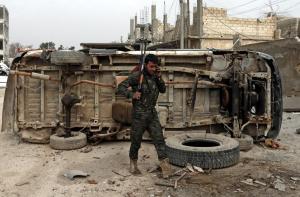
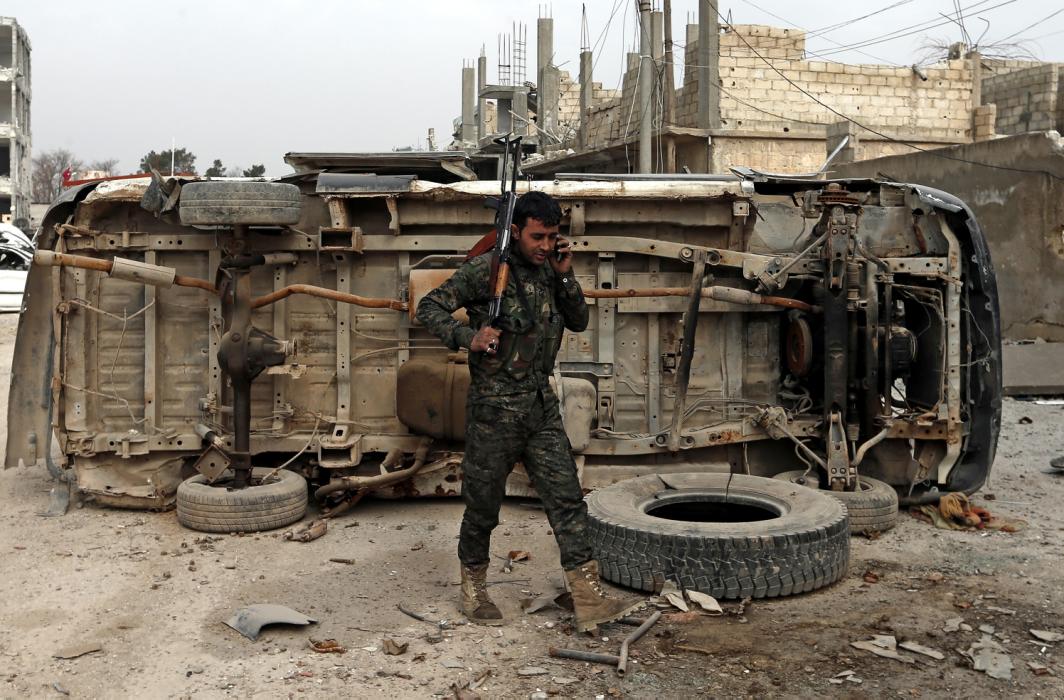
Photo: Kobane, Syria. A member of the Syrian Kurdish People’s Defense Units walks amidst some of the town’s destruction. January 28th. Credit: Sedat Suna/EPA.
This Week in War.
This Week in War. A Friday round-up of what happened and what’s been written in the world of war and military/security affairs this week. It’s a mix of news reports, policy briefs, blog posts and longform journalism.
- A coup attempt in Gambia was repelled on Tuesday, and dozens of suspects are now being held and interrogated.
- Peter Bouckaert and Marcus Bleasdale travel through the Central African Republic — documenting a largely ignored conflict.
- More than 76,000 people died in Syria in 2014, 3,500 of them children.
- Young men from Syria’s lost generation live in a state of limbo in Turkey — pursued by the Islamic State, disillusioned with insurgency and bereft of many of the people they have loved.
- Rukmini Callimachi reports on the cost of the post-9/11 interpretations of the zero concessions policy when it comes to hostage negotiations.
- The New York Times has a fabulous visualization of the development of the air war against the Islamic State.
- The US has begun training for the first set of Iraqi troops for a spring offensive.
- Saudi Arabia has arrested a man, one of 23 wanted by authorities, for creating unrest and acting on the behalf of a foreign power (usually meaning Iran).
- 26 were killed in a suicide bombing in central Yemen Wednesday.
- Egypt has ordered a retrial of the Al Jazeera journalists. Peter Greste’s family hasapplied to have him deported to Australia.
- Palestinian president Mahmoud Abbas has moved to join the International Criminal Court.
- A US drone strike in Somalia likely killed an Al-Shabab leader, identified by the US as the group’s chief of intelligence.
- As the US takes on a new support mission in Afghanistan, Resolute Support, it also begins a new counterterrorism operation — Freedom’s Sentinel.
- Islamabad’s police re-arrested a Lashkar-e-Taiba senior commander, Zaki-ur-Rehman Lakhvi, on kidnapping charges. Lakhvi was previously of being behind the 2008 attacks on Mumbai.
- The US named nine new targets of Iran sanctions.
- Putin critic Alexei Navalny was given a suspended sentence on fraud charges, only to be arrested hours later for breaking house arrest and joining an opposition rally.
- China and Japan take their territorial dispute over islands in the East China Seaonline.
- A new police unit has taken over investigation of Northern Ireland’s Bloody Sunday tragedy.
- The Guardian chose AFP photographer Bulent Kilic as their photographer of the year for his incredible work documenting protests and conflict in Ukraine and the refugee situation in Turkey.
- Five Guantánamo Bay prisoners were released just before the new year, all sent to Kazakhstan as free men. This brings the number transferred this year up to 28.
- Dzhokhar Tsarnaev has been denied a trial delay and a location shift away from Boston. Jury selection starts Monday.
- Air Force veteran Dan Mould’s chemical burns, wounds from a 2004 chemical weapons accident, were studied closely by the military. As a result, they came to new conclusions about long-term care and monitoring for such injuries — yet they have never provided this for Mould himself.
- Just Security picked 14 heroes of national security law for 2014 — people like the Hon. Gladys Kessler for her rulings in the Guantánamo force-feeding cases and James Risen for standing his ground and refusing to reveal his confidential source.
- Over at PRI, Max Rosenthal rounds up all the ways you were spied on in 2014.
- Shortly before 9/11, the American intelligence community published an 85-page report predicting what they thought the world would look like in 2015.
- And, a special way to remember the late 2014 by — last week’s full-year round-upof war across the globe.
Photo: Bagram Air Field, Parwan province, Afghanistan. December 23rd — the shadow of a soldier with the 3rd Cavalry Regiment falls on a sign painted on a blast barrier. Lucas Jackson/Reuters.
A Year in War: Revisiting the conflict and security-related events of 2014…
- Three months of anti-government protests and violent clashes in Ukraine, which started in late 2013 and culminated at the end of February, toppled the pro-Russian presidency of Viktor Yanukovych. In the following months, pro-Russian Ukrainians staged escalating protests and revolts of their own.
- In March, Russia brazenly annexed Crimea, formerly part of Ukraine, in what was just the beginning of a long and bloody standoff. A month later, pro-Russian separatists declared themselves Donetsk People’s Republic in eastern Ukraine, and have since regularly battled government forces with help from Russia. A Ukrainian ceasefire this fall collapsed — if, as Julia Ioffe points out, you could ever say it had actually existed. The war’s overall death toll is nearing 5,000 and more than a quarter of those fatalities have occurred since the declared cease-fire. Russia’s annexation of Crimea and involvement in eastern Ukraine have ramped up fears and strained diplomacy in Europe and the former Soviet bloc. Worries have intensified not only in countries like Georgia and Moldova, but in Sweden, where the armed forces found hard evidence their waters were breached by a foreign submarine, likely Russian, in October.
- In mid-July, after a few months of fighting and shooting down Ukrainian aircraft, separatists shot down Malaysia Airlines Flight 17, killing all on board. The crash site and investigation became entangled in hostilities
- Despite some of its boldness, Russia’s economy is seriously suffering, largely as a result of dropping oil prices, but it’s also bending under the weight of sanctions, inflation and a compromised pension system.
- This year, Chechnya marked two anniversaries — the ten years since the awful Beslan school siege and the two decades since the beginning of the first Chechen war. This winter also saw some fresh violence – a gun battle between Islamist militants and government forces in Grozny this December left 20 dead and since then human rights workers who raised concerns about government actions have been seriously threatened and harassed.
- The Georgian government wants to prosecute former president Mikhail Saakashvili, who currently calls Brooklyn’s hip Williamsburg neighborhood home, for human rights violations.
- In other long-running conflict news, more than a dozen were killed this summer in fighting over the contested territory of Nagorno-Karabakh. This was the worst such fighting between Azerbaijan and Armenia since 1994. Azerbaijan also shot down an Armenian helicopter in November.
- Lebanon struggled with spillover from the Syrian conflict, particularly with handling the volume of refugees – turning some away. Meanwhile, more than a billion dollars of Iraq reconstruction money wound up in a Lebanese bunker.
- In January, an international tribunal opened hearings in the Netherlands regarding the 2005 assassination of former Lebanese prime minister Rafik Hariri.
- A Jordanian court cleared radical cleric Abu Qatada, extradited last year from the UK, of all charges related to the Millennium Plot and released him from prison.
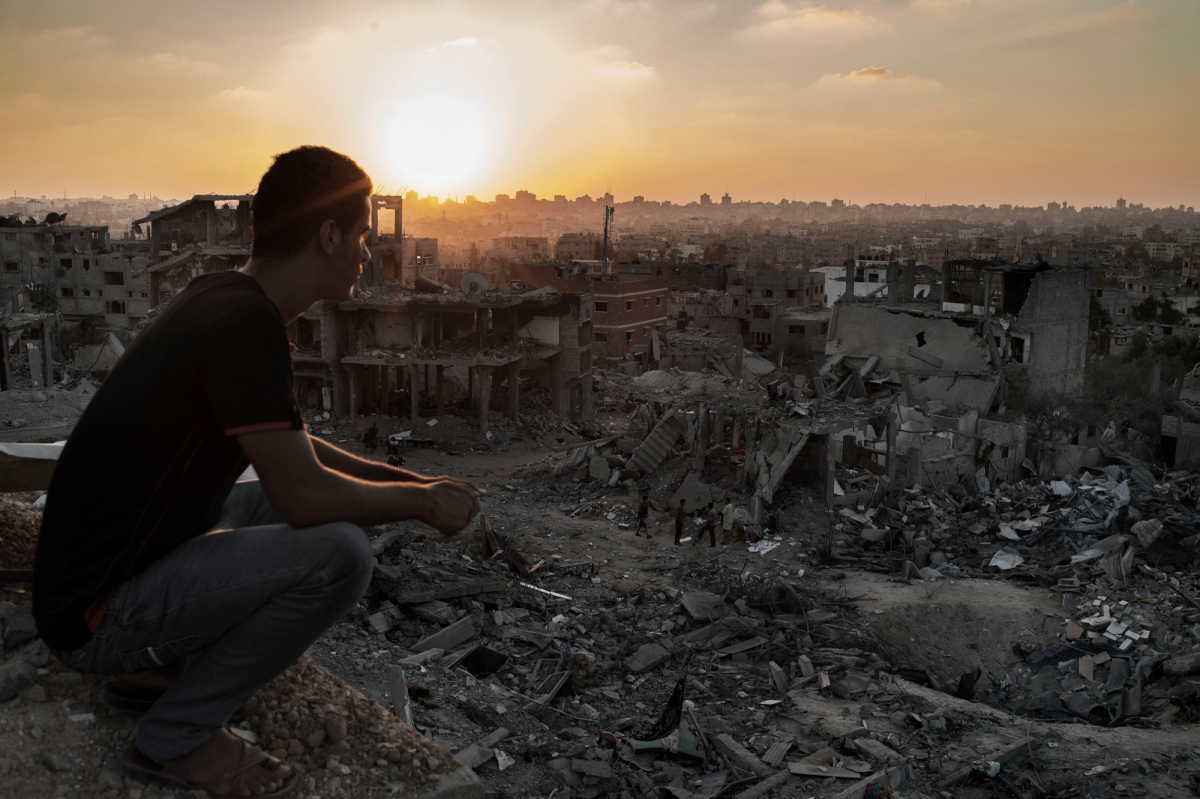
- This summer, Israel and Gaza engaged in a costly 50 day war in which nearly 2200 Gazans died, more than 1500 of them civilians and 500 of them children. From the 8th of July to the 26th of August, Israel bombarded the Gaza Strip in Operation Protective Edge, a war begun after the kidnapping and killing of three Israeli teenagers. Over the course of their onslaught against the densely inhabited strip of land, 18,000 houses were destroyed and many tens of thousands were damaged. 66 Israeli soldiers and 6 Israeli civilians, one of them a child, died in the fighting and return fire. Palestinian author Atef Abu Saif wrote a haunting war diary of eight days under fire in the Gaza Strip. The wholesale destruction is painfully evident in the photographs from Gaza during that period.
- Human Rights Watch investigated three attacks carried out by Israel against schools in Gaza, concluding that Israel had attacked well-marked schools where civilians were sheltering, in violation of the laws of war. Amnesty International also found evidence of Israeli violations, like failure to provide civilians with prior warnings, and describes the civilian costs as disproportionate to any successful targeting of militants. The United Nations began an inquiry this month into Israeli shelling of UN facilities and into the storage of rockets at vacated UN buildings, an inquiry with which Israel and Hamas have both promised to cooperate. Israel is refusing to cooperate with another inquiry, this one by the UN Human Rights Council into possible war crimes. At the very end of the conflict, Hamas executed dozens of unnamed Gazans for crimes of collaboration.
- This week Palestinians submitted a draft resolution to the UN Security Council which demands the withdrawal of Israeli troops by 2017. It isn’t remotely likely to pass, but it does complicate the international politics of supporting Israeli positions.
- Israel’s expansive settlement plans in Jerusalem this year have also drawn condemnation internationally.
- In early December, Israel’s Knesset voted to dissolve its parliament and hold early elections.
- Luke Somers, an American photojournalist, and Pierre Korkie, a South African aid worker, both died during a failed special ops rescue attempt. They had been held by Al Qaeda in the Arabian Peninsula (AQAP) and were killed by their captors during the mission. BuzzFeed’s Gregory Johnsen wrote about his own close call reporting in Yemen.
- Houthi rebels in Yemen overtook the capital in September, forcing the government to step down. The rebels, a Shiite force, are allied with those loyal to former president Ali Abdullah Saleh against the current president. Their seizureof the capital met with Sunni attacks and car bombings. Al-Qaeda in the Arabian Peninsula has declared war on the Houthi and expanded its own operations against the military. The Houthi are also friendly with Iran, and Saudi Arabia has signaled its displeasure by pulling most of its financial aid to Yemen. The parliament approved a new government in mid-December. The US hassanctioned Saleh and rebel leaders for threatening peace and stability in Yemen.
- The Syrian death toll is believed by some groups to have passed 200,000 in a war that has raged for more than three years.
- The US launched airstrikes against the Islamic State in Iraq and Syria and plans to begin training moderate Syrian rebels in the fight against the Islamic State. Here’s the text of the authorization for use of military force against IS – passed in December. Iran also launched air strikes against the Islamic State in the past month. In Syria, the Islamic State has engaged in tense rivalry with Al Nusra Front, also subject to American strikes
- The Islamic State has really defined war in 2014, at least for the West and the Middle East — and has been the subject of a great deal of fantastic reporting and academic analysis. Martin Chulov at the Guardian reported on the group’s origins in Camp Bucca in Iraq. Charles Lister extensively profiled the group for Brookings. Journalists at Spiegel examined why the group had such success at drawing young, disaffected Europeans to their cause. Zeit extensively researchedthe economic reality of the caliphate, which the group declared in June.
- Beginning in August, the Islamic State began beheading American and British journalists and humanitarian aid workers in a series of propaganda snuff films released on YouTube, for the most part every fortnight. Rukmini Callimachi’sreporting chronicles the experiences of the group’s captive Westerners. The murdered hostages, whose deaths have sparked an intense debate over the zero concessions policies about hostage negotiations, are James Foley, Steven Sotloff, David Hawthorne Caines, Alan Henning and Abdulrahman (formerly Peter) Kassig. An unnamed 26-year-old American aid worker remains the only known American hostage in ISIS hands. Another hostage, Briton John Cantlie, hasperiodically appeared in propaganda films, forced to play correspondent for the group’s YouTube news clips.
- Theo Padnos, a prisoner of the Al Nusra Front, was released this summer.
- The Islamic State hasn’t simply terrorized Western hostages, but has been battling Kurdish forces in Iraq and Syria and slaughtered its way through its new territorial holdings this year.
- Following the revelation that the Iraqi army had more than 50,000 “ghost” soldiers on its payroll, Prime Minister Haider al-Abadi fired a number of senior officials as a consequence. Al-Abadi took office this after his predecessor, Nouri al-Maliki stepped down this summer.
- A New York Times investigation uncovered the impacts of remnant chemical weapons stores on US troops deployed to Iraq.
- Iran and the P5+1 made headway on nuclear negotiations, but failed to come to an agreement by the late November deadline. Talks have been given a seven month extension.
- Iran jailed four US-Iranian journalists in July — including Washington Postreporter Jason Rezaian, who remains in custody, ambiguously charged.
- In mid-April, the Boko Haram terror group kidnapped more than 200 school-age girls in the Nigerian town of Chibok — while a few dozen escaped, and hopes of mass release were briefly elevated in October, it is really no longer actually possible for them to be freed as a group. Boko Haram, meanwhile, a group founded in 2009, killed 2000 people in the first half of 2014 alone. This summer and fall, they began attacking sizable towns and cities in their stronghold in the northeast, where the violence of their campaign has displaced 1.6 million people.
- Conflict has been ongoing in the Central African Republic since Seleka rebels seized the capital city of Bangui in March of 2013. In 2014, the conflict is a sectarian one in which the Muslim Seleka first targeted the majority Christian population. Following the ousting of Seleka this year, Christian militias have in turn slaughtered Muslim citizens by the thousands. As many as 10,000 children are now fighting in the conflict in the Central African Republic, in a range from either double or quadruple the number of child soldiers involved a year ago. In the British edition of GQ, Ed Caesar wrote on this under-covered and brutal tit-for-tat ethnic cleansing in the aptly titled and gorgeously narrated “Hell is Other People.” In another piece, Graeme Wood writes that the country’s capital, Bangui, is a “city of overlapping vendettas.” And finally, Foreign Affairs asks, why has the Central African Republic had so many peacekeeping forces and operations, but no peace?
- War in the Democratic Republic of Congo has been ongoing since 1998. In that time, more than 5 million people have died from the violence, starvation and disease that have accompanied the war between the government and rebels. The war, triggered by the aftershocks of nearby Rwanda’s genocide, is one of the world’s bloodiest wars, the UN’s costliest peacekeeping operation ever, and one of the most ignored conflicts.
- Egypt’s former army chief, Abdel Fatah el-Sisi, took office for a four year term as president in June. He brought with him harsh repression tactics that rival those of the ousted dictatorship of Hosni Mubarak, who was this year cleared of charges related to the deaths of protesters in 2011 and corruption. Also in June, Australian Peter Greste, Canadian-Egyptian Mohammed Fahmy and Egyptian Baher Mohammed, all Al Jazeera journalists, were sentenced to 7 to 10 years in prison on charges that include spreading lies to aid the Muslim Brotherhood. This November, Sisi signaled some hope for a pardon.
- Libya, caught in a downward spiral of competing militant groups, is increasingly home to organizations supportive of the Islamic State. IS has reportedly set up training camps in the eastern part of the country. The city of Derna is controlledby the IS-allied Shura Council for the Youth of Islam in Derna as well as hundreds of fighters who have returned home to Libya after fighting in the Islamic State’s al-Battar Brigade in Deir Ezzor and Mosul. Spiegel reports on the expanding influence of IS – especially in North Africa, as a variety of militant groups seek to capitalize on their successes.
- A group of IS-aligned Algerian militants, the Caliphate Soldiers, beheaded a French hostage, a mountain guide named Hervé Gourdel. The group’s leader, Abdelmalik Gouri, has reportedly been killed by Algerian special forces.
- French citizen Serge Lazarevic was freed in Mali.
- Multiple rounds of peace talks between the Malian government and Tuareg rebel groups ended in late November without agreement.
- The deaths of nine UN peacekeepers in Mali, there to aid in stopping the aggressions of Al-Qaeda-linked rebels, led to calls for a more “robust” action.
- This past month, the Sudanese government failed to reach an agreement in talks with the rebels whom it has spent the past three years battling in the provinces of Blue Nile and South Kordofan.
- The UN is cutting its peacekeeping forces back in Darfur, although fighting has ramped up, and the International Criminal Court’s chief prosecutor has withdrawn the genocide case against President Omar Bashir because there has been no effort to arrest him.
- In South Sudan, tens of thousands have died after a year of conflict and 1.9 million have been displaced. The fighting, which broke out in December of 2013, is result of an armed rivalry between President Salva Kiir and his former VP Riek Machar. The UN has extended its mission there until at least May. Human Rights Watch said this summer that atrocities committed this year range from looting and pillaging to gang rape and civilian murder — the scale and depravity of which amount to war crimes.
- Fighting on the border between Sudan and South Sudan threatens to merge the wars of both countries.
- On December 6th, the International Criminal Court withdrew charges of crimes against humanity against sitting Kenyan president Uhuru Kenyatta.
- There are growing concerns about terrorism in Kenya, which marked the one year anniversary of the Westgate mall attack this September. Al-Shabab has recently launched a number of deadly cross-border attacks from neighboring Somalia.This month Kenya passed a controversial counterterrorism bill, backed by Kenyatta, which makes allowances for detentions without charge and for the domestic intelligence agency to conduct covert operations.
- In Somalia, peacekeepers from Uganda and Burundi used their hospital connections to find, exploit and assault women and girls.
- Bahraini human rights activist Maryam Al-Khawaja was sentenced in absentia to a year of jail time for allegedly assaulting two police officers in the country’s airport, where she was detained upon returning home from Europe.
- This year’s election in Afghanistan turned into a contentious and costly runoffbetween Ashraf Ghani, a technocrat with a warlord for a running mate, and Abdullah Abdullah, a former adviser to Ahmad Shah Massoud. Ghani was the ultimate victor in an election confirmed to have been full of fraud, but Abdullah is now the country’s Chief Executive Officer. And the US finally got its Bilateral Security Agreement.
- The US, which will leave behind more troops in Afghanistan in 2015 than previously planned, formally closed its combat command in December, paving the way for the support and training role that begins on January 1st. Along with this, the US closed the Bagram prison, saying it has no more prisoners in Afghanistan.
- A case against the US over tortures and detentions in Afghanistan is creeping forward in the ICC.
- This year was the deadliest year for Afghan civilians since the beginning of the war. The number of civilian casualties will likely pass 10,000 by the end of the year — a first since the UN began tallying civilian losses in 2008.
- In November, President Obama authorized a broader combat mission in Afghanistan than previously intended – moving to allow US troops a direct combat role for at least another year. Closely following that, Afghanistan’s new president, Ashraf Ghani, announced a resumption of the night raids banned by his predecessor. Under the retooled mission announced by the administration, US forces would likely provide support for Afghan forces in these raids.
- A Taliban offensive in the southern Sangin district this summer was some of theworst fighting there in years. The group has also increased its attacks on Kabul as the Afghanistan combat mission ends for the US and NATO.
- In mid-June, Pakistan launched an offensive against militants in the northwest regions of the country, causing hundreds of thousands to flee the uptick in violence in North Waziristan.
- Pakistan’s battles this year with the threat of the Tehreek-e-Taliban Pakistan(TTP), culminated terribly with a December TTP assault on an army public school in Peshawar. 141 people died — 132 of whom were school age children. Amid questions of what this will mean for Pakistan’s security and policy in future, the country has already ended its moratorium on the death penalty for terror offenses and has ramped up operations against the TTP in the northwest.
- Pakistan’s opposition leader Imran Khan and cleric Tahir ul-Qadri led weeks of protest against Prime Minister Nawaz Sharif, demonstrations which stoked fears of a “soft coup.”
- India and Pakistan have experienced some of the worst escalations of cross-border violence and hostility at Kashmir since a 2003 ceasefire.
- War in Syria and Taliban targeting of polio vaccination workers in Pakistan havedropped the vaccination rates for the disease, giving it an unwelcome upsurge. Some of the difficulty vaccinating in Pakistan is also a result of fallout from the CIA’s fake vaccination program to gather intelligence about the whereabouts of Osama bin Laden.
- India is sending 5000 more paramilitary troops to the northeastern state of Assam, where separatist attacks from the National Democratic Front of Bodoland killed 70 people earlier this week.
- On May 22nd, not too long after a Thai court removed Prime Minister Yingluck Shinawatra from power, the military staged a coup. It took control following a violent and contentious period in Thailand, beginning in late 2013 when protestsagainst Shinawatra’s government rocked the country. Since the coup, the military has engaged in crackdowns on activism, protest and dissent – jailing journalists, professors and student activists (who have been using the three-fingered Hunger Games salute).
- Pro-democracy protests in Hong Kong which arose this fall were dealt with harshly and violently. The Occupy encampments demonstrating against the anti-democratic rules of the Chinese-imposed electoral system were cleared by police with tear gas and batons, but have not been fully vanquished.
- The government of the Philippines signed a peace accord in March with the Moro National Liberation Front, ending forty years of war and seventeen years of negotiations. The fighting killed at least 120,000 people on the island of Mindanao over the course of the conflict.
- This December, a Swiss hostage escaped another group, Abu Sayyaf, also engaged in a long-term battle with the Filipino government. Abu Sayyaf released another hostage on Christmas Eve.
- A UN human rights envoy called attention in April to the ongoing persecution by the Burmese government of the Rohingya population, tens of thousands of whom are starving in disease-ridden refugee camps. Just weeks before, aid workers had been forced to evacuate after coming under attack from Buddhists but had been barred from returning by the government.
- This fall, China put prominent journalist Gao Yu on trial, charged with leaking state secrets.
- In Xinjiang province, China has been pursuing a harsh crackdown on Uighur terror cells, claiming to have so far eliminated 115 cells. This crackdown on terror is accompanied by repression and harassment of the ethnic Muslim Uighur population.
- North Korea released three American prisoners this fall. The country is alsoapparently behind the large hack of Sony Pictures Entertainment that targeted the release of The Interview, a comedy about taking down Kim Jong-Un. The hack included threats of violence and temporarily scuttled the movie’s release. North Korea denies involvement despite accusations. While the government and most reporting generally pins this on North Korea, the jury really is still out, as Kim Zetter reports.
- In a rather stunning turn of events, the FARC rebels in Colombia declared a unilateral, indefinite ceasefire beginning December 20th. The treaty, intended to turn into an armistice, has however been snubbed by the government.
- Following an entreaty from Pope Francis, secret negotiations and a prisoner trade, the US and Cuba resumed full diplomatic relations this month.
- Beginning early February, protests erupted in Venezuela over a range of issues, from inflation to political oppression. Dozens died in clashes and the government enacted violent repressions, including thousands of detentions after which some have reported torture.
- Two lone wolf terror attacks occurred in short order in Canada this fall. On October 20th in St-Jean-sur-Richelieu, Quebec, a radicalized Canadian man ran down and killed two soldiers. A few days later, a lone gunman, Michael Zehaf-Bibeau, shot and killed Cpl. Nathan Cirillo at the National War Memorial in Ottawa before moving on Parliament, where he was killed by the sergeant-at-arms.
- Australia foiled an Islamic State-inspired beheading plot and passed strict new anti-terror legislation. In Sydney just this month, a man named Man Haron Monis held a cafe’s staff and customers hostage for 16 hours, killing two before he himself was killed.
- The Irish Republican Army’s 1972 killing of Jean McConville, taken from her home in West Belfast reappeared in the news as the continuing police investigation led to the arrest of Sinn Fein politician and former IRA commander Gerry Adams. He was released after interrogation in April. The police have alsoarrested and released Bobby Storey, also a senior-level IRA commander. Two more men were arrested in connection with the case just this Monday.
- 30 former members of the IRA are also under investigation for child sexual abuse.
- Amnesty International is calling for an inquiry into the torture of 14 Northern Irish men detained without trial by the British Army in 1971. Northern Ireland’s attorney general has also ordered new inquests into the Troubles shooting deaths of two Belfast civilians by the army’s Military Reaction Force.
- The release of the Senate Select Committee’s torture report (or, really just the executive summary) offered the brutal details of the CIA’s post-9/11 Detention and Interrogation Program — with nauseating chronicles of sleep deprivation, sexual assault and waterboarding paired with damning depictions of CIA mismanagement and misinformation campaigns. Earlier this year, the CIA copped to tapping the computers of Senate staffers in the middle of reviewing the agency’s documents on the detention program.The debate over making the executive summary public came with a lot of decisions to make about what information would be redacted and scrubbed from the document, like the names of the other countries involved in renditions and black site prisons. Melville House is releasing the report as a book.
- There are also remain potentially thousands of unreleased photographs related to the torture of detainees held by the US.
- 23 prisoners were transferred from Guantánamo in 2014, and there are promises of more to come.
- December: 4 Afghans returned to Afghanistan; 6 detainees accepted by Uruguay
- November: 1 Saudi returned home, 5 transferred to Eastern Europe, 1 Kuwaiti man released
- May: 5 Taliban detainees swapped for Bowe Bergdahl, a controversial trade.
- Cliff Sloan, the State Department envoy responsible for negotiating the release of detainees, is resigning.
- There was turnover in the Pentagon: Chuck Hagel was unceremoniously oustedfrom his position as defense chief and will be replaced by Ashton Carter.
- Here’s the text of this year’s US defense authorization bill.
- American post-9/11 military costs have amounted to $1.6 trillion according to the Congressional Research Service.
- The Department of Veterans Affairs faced scandal, Congressional overhaul and the resignation of secretary Eric Shinseki after it was revealed that its hospital system covered up evidence of extensive waits for care in which some veteransdied before they could get treatment.
- A House investigation into the politically infamous events of Benghazi in 2013 turned up no evidence of administration wrongdoing.
- Although it isn’t the only interview out there now with Edward Snowden, NBC’sinterview with him in May sparked debate over the steps Snowden took within the NSA before he decided to leak information on secret programs.
- A jury convicted a Blackwater guard of first-degree murder and three others of manslaughter in the 2007 Nisour Square massacre in which Blackwater guards killed 17 Iraqi civilians.
- Data released by Reprieve calculates that for the 41 men targeted by drone strikes, 1,147 people had been killed. Steve Coll wrote about the drone war in Pakistan and its centrality to the Obama administration’s war on terror for The New Yorker.
- And finally, 2014 was the centennial anniversary of World War I.
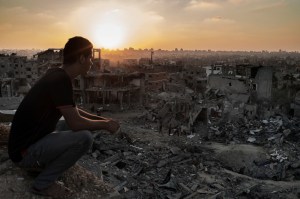 Photograph above: a man looks out over destruction in the Al Shaaf neighborhood of Gaza City, August 11th. Credit to Alessio Romenzi for TIME.
Some extras, a handful of really great war-related reads published this year not included above:
- Asra Nomani. “This is Danny Pearl’s Final Story.” The Washingtonian.
- Beth McMurtrie. “Secrets from Belfast.” The Chronicle of Higher Education
- Gregory Johnsen. “60 Words and a War Without End.” BuzzFeed.
- Mac MacClelland. “How to Build a Perfect Refugee Camp.” The New York Times.
- Justine van der Leun. “Portrait of a Township.” Harper’s.
- Paul Solataroff. “The Interpreters We Left Behind.” Men’s Journal.
- Eva Holland. “The Forgotten Internment.” Maisonneuve.
- Matthieu Aikins. “Whoever Saves a Life.” Matter.
- Richard Whittle. “How We Lost Mullah Omar.” Politico.
- Elliot Ackerman. “Pictures from My War.” The New Yorker.
- T. Christian Miller and Jonathan Jones. “Firestone and the Warlord.” ProPublica.
- Tom Ricks. “In and Out of Time in Iraq.” The New Yorker.
This Week in War
This Week in War. A Friday round-up of what happened and what’s been written in the world of war and military/security affairs this week. It’s a mix of news reports, policy briefs, blog posts and longform journalism.
- Kenyan parliament passed a contested, controversial counterterrorism bill — the bill allows extended detention without charge, removes checks and balances on the presidency and empowers the domestic intelligence agency to carry out covert operations.
- According to charity Save the Children, the number of child soldiers in the Central African Republic has more than doubled since last year. 6000-10000 boys and girls are now part of the fighting there.
- Tens of thousands of people have died this year in conflict in South Sudan.
- South Sudan has hired Erik Prince of Blackwater fame to help repair oil facilities damaged by the year of war.
- In Sierra Leone, Ebola’s tragedy occurs in the shadow of past conflict.
- Boko Haram has kidnapped 185 women and children, and killed 32 people, in the town of Gumsuri in northeastern Nigeria.
- Palestinians have convinced other Arab diplomats to support their UN draft resolution that includes a timeline for Israeli troop withdrawals, negotiation deadlines and outlines Palestinian statehood.
- The European Union has removed Hamas from its terrorist organizations list.
- 230 bodies believed to be victims of the Islamic State were found in a mass grave in the Syrian city of Deir al-Zour.
- The UN is appealing for $8.4 billion in aid for Syria from the international community.
- The US penalized companies providing fuel and oil to the Syrian government.
- Al Nusrah Front and Ahrar al-Sham have made advances against the Syrian regime in the northwestern province of Idlib. A forty-eight hour battle over two bases left 180 dead all told.
- A suicide bombing in central Yemen, aimed at a Shia militia leader, killed 25 — including 15 schoolchildren.
- Inside the race to save Peter Kassig.
- The Islamic State retook Baiji after Iraqi forces retreated to a nearby oil refinery.
- Kurdish forces say they have claimed a major victory, breaking the Islamic State’s siege of Mount Sinjar.
- The Pentagon also says they have killed a number of the group’s leaders in air strikes. This December, 97% of strikes were carried out by US planes, not by other allied forces.
- The Afghan Taliban publicly condemned the Pakistani Taliban’s attack.
- Afghanistan’s spy chief has said the absence of American and NATO forces has left an intelligence vacuum.
- The Taliban’s attacks in Afghanistan have also surged as the combat mission ends.
- European Union election observers confirm that there was extensive fraud in this year’s Afghan elections.
- The Pakistani Taliban killed 141 people, the vast majority of whom were children, in a vicious attack on an army public school in Peshawar. Three days of mourning were declared, and Prime Minister Nawaz Sharif brought back the death penalty in terrorism cases.
- A Q and A about the Pakistani Taliban’s origins.
- Air strikes and ground operations carried out by the army on Thursday and Friday in the northwest of Pakistan have so far killed 59 militants.
- Veteran diplomat Robin Raphel is now embroiled in an FBI counterintelligence investigation into whether or not she gave classified information to Pakistan.
- Economic turmoil in Russia could pressure Putin over Ukraine. The US is further increasing the strain by stepping up sanctions on Russia’s defense, energy and banking industries.
- The US and Cuba “cut loose the shackles of the past” and began to restore their diplomatic relationship after fifty years. The first step was a prisoner exchange, in which State Department contractor Alan Gross returned home — as did Rolando Sarraff Trujillo — a vital CIA mole in Cuban intelligence in prison for over twenty years.
- The FARC rebels in Colombia have declared a unilateral ceasefire beginning the 20th — a ceasefire they say is indefinite, and can turn depending on the government. The government, however, has snubbed the ceasefire.
- A 16-hour hostage situation in a Sydney café ended with two dead hostages, and a dead gunman — Man Haron Monis.
- Ten Bosnian Serb security officials during the war have been arrested on war crimes charges.
- The UK’s defense minister has said that women could have combat roles in the British Army as early as 2016.
- The body of man who was killed in a mass shooting in West Belfast by British troops in 1971 will be exhumed as part of an inquest into the events.
- After the Sony hack escalated with threats, the studio cancelled the release of The Interview. The hack has been publicly attributed to North Korea, but WIRED cautions that such attribution is extremely difficult and evidence is actually thin.
- The CIA chose speed and haste when it adopted the interrogation methods that amounted to torture, pushing aside debate and hiring the psychologists who designed the program without vetting.
- Abu Zubaydah — through his lawyer — reacts to the release of the report.
- Melville House is publishing the report in book form.
- An attorney for Guantánamo inmate Mustafa al-Hawsawi, an accused 9/11 plotter who was reportedly thrown to the ground by guards this month, has beenrebuffed in his bid to get urgent medical care for his client.
- The US has asked the Vatican for assistance in finding “humanitarian solutions” for transferring Guantánamo inmates.
- A pre-trial hearing was held for Boston bomber Dzokhar Tsarnaev.
- Experts gathered in Berlin to discuss how to protect the cultural artifacts of threatened countries like Syria.
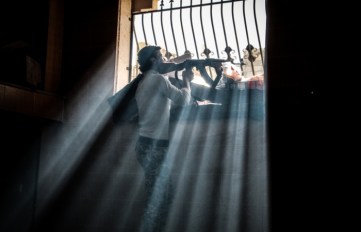
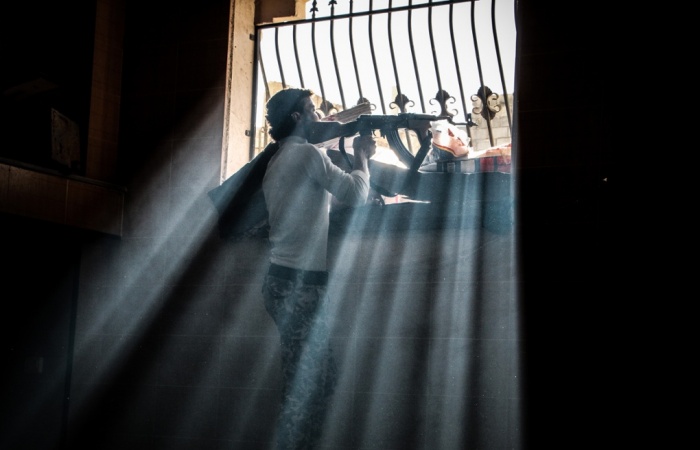
Photo: Aleppo, Syria. A rebel fighter keeps lookout. Karam AlMasri/Nur Photo/Rex
This Week In War.
A Friday round-up of what happened and what’s been written in the world of war and military/security affairs this week. It’s a mix of news reports, policy briefs, blog posts and longform journalism.
- The CIA torture report, or rather — the 525 page executive summary of the still-classified 6700 page report — has finally been released.
- The specifics include extensive allegations of CIA mismanagement and misinformation campaigns, a rejection of the argument that intelligence from torture resulted in the capture of bin Laden or the thwarting of numerous plots, and gruesome details of the brutal tactics used. The Washington Post chooses 20 key findings. And an infographic on the 119 detainees who went through the CIA’s program.
- Politico on what isn’t in the report.
- On the same day, Syrian activists released a report on human rights violations in Syrian government jails. Ishaan Tharoor compares the two.
- Here’s a starter kit for decoding some of the code-named and redacted black site references in the report.
- There have of course been spins, rebuttals and disagreements from the CIA camp — including a new website dedicating to combatting the arguments made by the report.
- The Guardian finds that the US used redactions to hide the UK’s role in the program.
- Sen. McCain: “Our enemies act without conscience. We must not.”
- From Eric Fair: “I was an interrogator at Abu Ghraib. I tortured.”
- The Washington Post contrasts former CIA director Michael Hayden’s claims about the Detention and Interrogation Program with the report.
- Mapping the rise of Boko Haram.
- The French military killed Ahmed el Tilemsi, co-founder of the Al-Qaeda linked group Movement for Tawhid and Jihad in West Africa (MUJAO), in a special operations raid in Mali.
- French hostage Serge Lazarevic has been freed after being held captive for three years by Al Qaeda in the Islamic Maghreb.
- Peace talks in Sudan fail to end in an accord.
- A former Chadian rebel leader has been arrested in the Central African Republic.
- Amnesty International says that the ability of leaders to commit atrocities with impunity and lack of war crimes investigations allows more atrocities to occur.
- At least seven women have been killed in attacks by Al-Shabaab in Somalia this week.
- A senior minister in the Abbas administer, Palestinian politician Ziad Abu Ein, died after a clash with Israeli troops, the exact causes of his death disputed.
- According to rebels in northern Syria, the US has ceased payments and arms shipments.
- A Special Operations Forces operation to rescue American hostage Luke Somers in Yemen ended in the death of Somers and his fellow South African captive Pierre Korkie.
- The Guardian‘s Martin Chulovreported an incredible longform piece on the origins of the Islamic State in the Camp Bucca prison in southern Iraq.
- The Senate Foreign Relations Committee approved a draft authorization for the use of military force against the Islamic State. [PDF]. Lawfare on the breadth and scope sought by the Obama administration for this new AUMF.
- The Gulf Cooperation Council launches a joint military command.
- Two suicide bombers in Kabul kill at least 6.
- In Rolling Stone, an exploration of the making of the Afghan narco-state.
- The US and NATO formally ended their operational command in Afghanistan on Monday.
- The US has also closed down Bagram detention facility.
- The US “transferred custody” of senior Pakistani Taliban commander Latif Mehsud and two others to Pakistan.
- Iran has charged Washington Post reporter Jason Rezaian, but it isn’t clear with what.
- This week is the 20th anniversary of the start of the first Chechnya war. Here is a collection of photojournalist Stanley Greene’s haunting images of that time.
- Britain asks NATO for assistance in hunting for a possible submarine spotted off the Scottish coast.
- A judge has given the US a deadline of next Tuesday to decide whether to push onward with the subpoena of reporter James Risen
- Six Guantánamo Bay prisoners have been resettled in Uruguay.
- The Ninth Circuit court has heard oral arguments in the Fourth Amendment challenge to NSA metadata collection (Smith v. Obama).
- The Austrian parliament passed anti-terrorism legislation that criminalizes the symbols of the Islamic State and Al Qaeda.
- According to BBC research, 5000 people died in November from so-called “jihadist” violence.
- A lost collection of photographs from the Vietnam War.
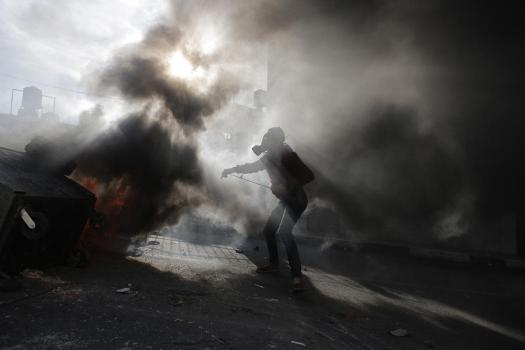
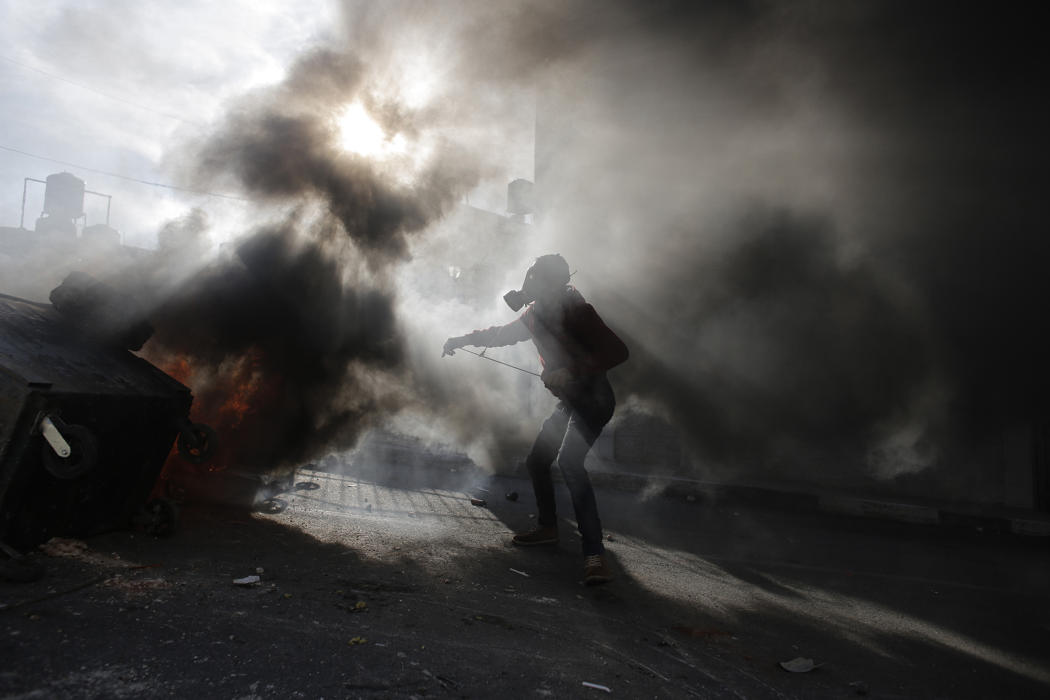
Photo: Ramallah, West Bank. A Palestinian protesters moves behind a burning tire amid clouds of tear gas following the funeral of Ziad Abu Ein on December 11th. Ammar Awad/Reuters.
The Geopolitics of World War III
Contrary to popular belief, conduct of nation’s on the international stage is almost never driven by moral considerations. Rather by a shadowy cocktail of money-geopolitics. As such when you see the mouthpieces of the ruling class begin to demonize a foreign country, the first question on your mind should always be- “what is actually at stake here?”
For the last six years the Federal Reserve has pumped over $110 million dollars into the U.S. economy – every single hour. This stimulus program is called Quantitative Easing, or as it’s more commonly known, QE.
On September 30th, 2013 the U.S. national debt was sitting at$16,738,183,526,697.32. As I write this, the U.S. national debt is sitting at $17,997,912,502,715. 74. That means that the U.S. national debt has actually grown by more than a trillion dollars in less than 12 months.
This is the greatest government debt bubble in the history of the world, yet very few people seem to have any desire to do anything about this.
The U.S. national debt has increased by more than 7 trillion dollars since Barack Obama has been in the White House. By the time Obama’s second term is over, we will have accumulated about as much new debt under his leadership than we did under all of the other U.S. presidents in all of U.S. history combined.
Cloward and Piven taught that America could only be destroyed from within. Only by overwhelming the system with debt, welfare, and entitlements could capitalism and the America economy be destroyed. So the plan was to make a majority of Americans dependent on welfare, food stamps, disability, unemployment, and entitlements of all kinds. Then, under the weight of the debt, the system would implode and the economy collapse, bankrupting business owners (i.e. conservative donors). Americans would be brought to their knees, begging for big government to save them.
For some time now Russia, China, Iran and Syria have been in the cross hairs. Once you understand why, events unfolding in the world right now will make much more sense.
The US dollar is a truly unique currency, in fact it’s current design and its relationship to geopolitics is unlike any other in history. Though it has been the world reserve currency since 1945, this is not what makes it unique. Many currencies have held the reserve status off and on over the centuries. What makes the dollar unique is the fact that since the early 1970s it has been with a few notable exceptions- the only currency used to buy and sell oil on the global market.
Prior to 1971 the U.S. dollar was bound to the gold standard, at least officially. According to the IMF, by 1966, foreign central banks held $14 billion in U.S. dollars, however the United States only had $3.2 billion in gold allocated to cover foreign holdings. Translation: Federal Reserve is printing more money than it can actually back. The result was Rampant Inflation and a general flight from the dollar.
In 1971 in what later came to be called the “Nixon Shock”, President Nixon removed the dollar from the gold standard completely. Quoting Nixon, “I have directed the Secretary of the Treasury to take the action necessary to defend the dollar against the speculators. I have directed Secretary Connally to suspend temporarily the convertibility of the dollar in the gold or other reserve assets, except in amounts and conditions determined to be in the interest on monetary stability and in the best interest of the United States”
Modern Money Mechanics
At this point the dollar became appear debt based currency. With debt based currencies money is literally loaned into existence. Approximately 70% of the money in circulation is created by ordinary banks which are allowed to loan out more money than they actually have in their accounts. The rest is created by the Federal Reserve which loans out money that they don’t have, mostly to government. It’s like writing hot checks, except it’s legal, for banks. This practice which is referred to as fractional reserve banking is supposedly regulated by the Federal Reserve; an institution which just happens to be only controlled by a conglomerate of banks, and no agency or branch of government regulates the Federal Reserve.
Quoting from the documentary directly, “ What is the proper relationship, what should be the proper relationship between the Chamber of the Fed and the President of the United States? Well first of all, the Federal Reserve is an independent agency and that means basically that there is no other agency of government which can overrule actions that we take. So long is that is in place and there is no evidence that the Administration or the Congress or anybody else is requesting that we do things other than what we think is the appropriate thing, then what the relationships are don’t frankly matter”
The infinite Growth Paradigm
These fractional reserve loans have interest attached. But the money that pay that interest doesn’t exist in the system. As a result there’s always more total debt than there is money in circulation, and in order to stay afloat the economy must grow perpetually. This is obviously not sustainable. You might be wondering how the dollar has maintained such a dominant position on the world stage for over 40 years, if it’s really little more than an elaborate ponzi scheme.
This is where the dollar meets geopolitics. In 1973, under the shadow of the artificial OPEC oil crisis, the Nixon administration began secret negotiations with the government of Saudi Arabia to establish what later became to be referred to as the Petrodollar Recycling System. Under the arrangement, the Saudis would only sell their oil in U.S. dollars and it would invest the majority of their excess profits in the U.S. banks and Capital markets.
The IMF would then use money to facilitate loans to oil importers who were having difficulties covering the increase in oil prices. The interest and payments on these loans would of course be denominated in U.S dollars. This agreement was formalized in “The U.S.-Saudi Arabian Joint Commission on Economic Cooperation”put together by Nixon’s Secretary of State Henry Kissinger in 1974.
Another document released by the Congressional Research Service reveals that these negotiations had an edge to them, as U.S. officials were openly discussing the feasibility of seizing oil fields in Saudi Arabia militarily.
In the United States, the oil shocks produced inflation, new concern about foreign investment from oil producing countries, and open speculation about the advisability and feasibility of militarily seizing oil fields in Saudi Arabia or other countries.
In the wake of the embargo, both Saudi and U.S. officials worked to re-anchor the bilateral relationship on the basis of shared opposition to Communism, renewed military cooperation, and through economic initiatives that promoted the recycling of Saudi petrodollars to the United States via Saudi investment in infrastructure, industrial expansion, and U.S. securities.
The system was expanded to include the rest of OPEC by 1975.
Though presented as a buffer to the recessionary effects of rising oil prices, this arrangement had a hidden side effect. It removed the traditional restraints on U.S. monetary policy.
The Federal Reserve was now free to increase the money supply at will. The ever increasing demand for oil would prevent a flight from the dollar, while distributing the inflationary consequences across the entire planet.
The dollar went from being a gold backed currency to an oil backed currency. It also became America’s primary export. Did you ever wonder how the U.S. economy has been able to stay afloat while running multibillion dollar trade deficits for decades? Did you ever wonder how it is that the U.S. holds such a disproportionate amount of the world’s wealth when 70% of the U.S. economy is consumer based?
In the modern era, fossil fuels make the world go round. It had become integrated into every aspect of civilization: agriculture, transportation, plastics, heating, defense, medicine and demand just keeps growing. As long as the world needs oil and as long as oil is only sold in U.S. dollars, there will be a demand for U.S. dollars, and that demand is what gives the dollar its value.
For the United States this is a great deal. Dollars go out, either as paper or in digits in a computer system, and real tangible products and services come in. However for the rest of the world- a very sneaky form of exploitation.
Having global trade predominately in dollars also provides Washington with the power financial weapon through sanctions. This is due to the fact that most large scale dollar transactions are forced to pass through the the U.S. This petrodollar system stood unchallenged until September of 2000 when Saddam Hussein announced his decision to switch Iraqi’s oil sales off the dollar to Euros. This was a direct attack on the dollar, and easily the most important geopolitical event of the year, but only one article in the western media even mentioned it.
In the same month that Saddam announced he was moving away from the dollar, an organization called the “The Project for a New American Century”, of which Dick Cheney just happened to be a member, released a document entitled “REBUILDING AMERICA’S DEFENSES Strategy, Forces and Resources For a New Century”.
This document called for massive increases in U.S. military spending and a much more aggressive foreign policy in order to expand U.S. dominance world wide. However the document lamented that achieving these goals would take many years “absent some catastrophic and catalyzing event – like a new Pearl Harbor”.
We are on a road that leads straight to the World War 3, but in order to see that and to fully understand what is at stake you have to look at the big picture and connect the dots. This video examines the history of the dollar, its relation to oil, and the real motives behind the wars of the past two decades.
The following are 11 international agreements that are nails in the coffin of the petrodollar.
#1 China And Russia
China and Russia have decided to start using their own currencies when trading with each other. The following is from a China Daily article about this important agreement….
China and Russia have decided to renounce the US dollar and resort to using their own currencies for bilateral trade, Premier Wen Jiabao and his Russian counterpart Vladimir Putin announced late on Tuesday.
Chinese experts said the move reflected closer relations between Beijing and Moscow and is not aimed at challenging the dollar, but to protect their domestic economies.
“About trade settlement, we have decided to use our own currencies,” Putin said at a joint news conference with Wen in St. Petersburg.
The two countries were accustomed to using other currencies, especially the dollar, for bilateral trade. Since the financial crisis, however, high-ranking officials on both sides began to explore other possibilities.
#2 China And Brazil
Did you know that Brazil conducts more trade with China than with anyone else?
The largest economy in South America has just agreed to a huge currency swap deal with the largest economy in Asia. The following is from a recent BBC article….
China and Brazil have agreed a currency swap deal in a bid to safeguard against any global financial crisis and strengthen their trade ties.
It will allow their respective central banks to exchange local currencies worth up to 60bn reais or 190bn yuan ($30bn; £19bn).
The amount can be used to shore up reserves in times of crisis or put towards boosting bilateral trade.
#3 China And Australia
Did you know that Australia conducts more trade with China than with anyone else?
Australia also recently agreed to a huge currency swap deal with China. The following is from a recent Financial Express article….
The central banks of China and Australia signed a A$30 billion ($31.2 billion) currency-swap agreement to ensure the availability of capital between the trading partners, the Reserve Bank of Australia said.
“The main purposes of the swap agreement are to support trade and investment between Australia and China, particularly in local-currency terms, and to strengthen bilateral financial cooperation,” the RBA said in a statement on its website. “The agreement reflects the increasing opportunities available to settle trade between the two countries in Chinese renminbi and to make RMB-denominated investments.”
China has been expanding currency-swap accords as it promotes the international use of the yuan, and the accord with Australia follows similar deals with nations including South Korea, Turkey and Kazakhstan. China is Australia’s biggest trading partner and accounts for about a quarter of the nation’s merchandise sales abroad.
#4 China And Japan
The second and third largest economies on the entire planet have decided that they should start moving toward using their own currencies when trading with each other. This agreement was incredibly important but it was almost totally ignored by the U.S. media.
According to Bloomberg, it is anticipated that this agreement will strengthen ties between these two Asian giants….
Japan and China will promote direct trading of the yen and yuan without using dollars and will encourage the development of a market for companies involved in the exchanges, the Japanese government said.
Japan will also apply to buy Chinese bonds next year, allowing the investment of renminbi that leaves China during the transactions, the Japanese government said in a statement after a meeting between Prime Minister Yoshihiko Noda and Chinese Premier Wen Jiabao in Beijing yesterday. Encouraging direct yen- yuan settlement should reduce currency risks and trading costs, the Japanese and Chinese governments said.
China is Japan’s biggest trading partner with 26.5 trillion yen ($340 billion) in two-way transactions last year, from 9.2 trillion yen a decade earlier.
#5 India And Japan
It is not just China making these kinds of currency agreements. According to Reuters, India and Japan have also agreed to a very large currency swap deal….
India and Japan have agreed to a $15 billion currency swap line, Japan’s Prime Minister Yoshihiko Noda said on Wednesday, in a positive move for the troubled Indian rupee, Asia’s worst-performing currency this year.
#6 “Junk For Oil”: How India And China Are Buying Oil From Iran
Iran is still selling lots of oil. They just aren’t exchanging that oil for U.S. dollars as much these days.
So how is Iran selling their oil without using dollars?
A Bloomberg article recently detailed what countries such as China and India are exchanging for Iranian oil….
Iran and its leading oil buyers, China and India, are finding ways to skirt U.S. and European Union financial sanctions on the Islamic republic by agreeing to trade oil for local currencies and goods including wheat, soybean meal and consumer products.
India, the second-biggest importer of Iran’s oil, has set up a rupee account at a state-owned bank to settle as much as much as 45 percent of its bill, according to Indian officials. China, Iran’s largest oil customer, already settles some of its oil debts through barter, Mahmoud Bahmani, Iran’s central bank governor, said Feb. 28. Iran also has sought to trade oil for wheat from Pakistan and Russia, according to media reports from the two countries.
#7 Iran And Russia
According to Bloomberg, Iran and Russia have decided to discard the U.S. dollar and use their own currencies when trading with each other….
Iran and Russia replaced the U.S. dollar with their national currencies in bilateral trade, Iran’s state-run Fars news agency reported, citing Seyed Reza Sajjadi, the Iranian ambassador in Moscow.
The proposal to switch to the ruble and the rial was raised by Russian President Dmitry Medvedev at a meeting with his Iranian counterpart, Mahmoud Ahmadinejad, in Astana, Kazakhstan, of the Shanghai Cooperation Organization, the ambassador said.
#8 China And Chile
China and Chile recently signed a new agreement that will dramatically expand trade between the two nations and that is also likely to lead to significant currency swaps between the two countries….
The following is from a recent report that described this new agreement between China and Chile….
When called on the two nations to expand trade in goods, promote trade in services and mutual investment, and double bilateral trade in three years.
The Chinese leader also said the two countries should enhance cooperation in mining, expand farm product trade, and promote cooperation in farm product production and processing and agricultural technology.
China would like to be actively engaged in Chile’s infrastructure construction and work with Chile to promote the development of transportation networks in Latin America, said Wen.
Meanwhile, Wen suggested that the two sides launch currency swaps and expand settlement in China’s renminbi.
#9 China And The United Arab Emirates
According to CNN, China and the United Arab Emirates recently agreed to a very large currency swap deal….
In January, Chinese Premier Wen Jiabao visited the United Arab Emirates and signed a $5.5 billion currency swap deal to boost trade and investments between the two countries.
#10 China And Africa
Did you know that China is now Africa’s biggest trading partner?
For many years the U.S. dollar was dominant in Africa, but now that is changing. A report from Africa’s largest bank, Standard Bank, says the following….
“We expect at least $100 billion (about R768 billion) in Sino-African trade – more than the total bilateral trade between China and Africa in 2010 – to be settled in the renminbi by 2015.”
#11 Brazil, Russia, India, China And South Africa
The BRICS (Brazil, Russia, India, China and South Africa) continue to become a larger factor in the global economy.
A recent agreement between those nations sets the stage for them to increasingly use their own national currencies when trading with each other rather than the U.S. dollar. The following is from a news source in India….
The five major emerging economies of BRICS — Brazil, Russia, India, China and South Africa — are set to inject greater economic momentum into their grouping by signing two pacts for promoting intra-BRICS trade at the fourth summit of their leaders here Thursday.
The two agreements that will enable credit facility in local currency for businesses of BRICS countries will be signed in the presence of the leaders of the five countries, Sudhir Vyas, secretary (economic relations) in the external affairs ministry, told reporters here.
The pacts are expected to scale up intra-BRICS trade which has been growing at the rate of 28 percent over the last few years, but at $230 billion, remains much below the potential of the five economic powerhouses.
So what does all of this mean?
It means that the days of the U.S. dollar being the de facto reserve currency of the world are numbered.
So why is this important?
In a previous article, I quoted an outstanding article by Marin Katusa that detailed many of the important benefits that the petrodollar system has had for the U.S. economy….
The “petrodollar” system was a brilliant political and economic move. It forced the world’s oil money to flow through the US Federal Reserve, creating ever-growing international demand for both US dollars and US debt, while essentially letting the US pretty much own the world’s oil for free, since oil’s value is denominated in a currency that America controls and prints. The petrodollar system spread beyond oil: the majority of international trade is done in US dollars. That means that from Russia to China, Brazil to South Korea, every country aims to maximize the US-dollar surplus garnered from its export trade to buy oil.
The US has reaped many rewards. As oil usage increased in the 1980s, demand for the US dollar rose with it, lifting the US economy to new heights. But even without economic success at home the US dollar would have soared, because the petrodollar system created consistent international demand for US dollars, which in turn gained in value. A strong US dollar allowed Americans to buy imported goods at a massive discount – the petrodollar system essentially creating a subsidy for US consumers at the expense of the rest of the world. Here, finally, the US hit on a downside: The availability of cheap imports hit the US manufacturing industry hard, and the disappearance of manufacturing jobs remains one of the biggest challenges in resurrecting the US economy today.
So what happens when the petrodollar dies?
The following are some of the things we are likely to see….
-Oil will cost a lot more.
-Everything will cost a lot more.
-There will be a lot less foreign demand for U.S. government debt.
-Interest rates on U.S. government debt will rise
-Interest rates on just about everything in the U.S. economy will rise.
And that is just for starters.
As I wrote about earlier today, the Federal Reserve is not going to save us. Fundamental changes to the global financial system are happening right now that are impossible to stop.
We should have never gone into so much debt. Up until now we have gotten away with it, but when demand for U.S. dollars and U.S. debt dries up we are going to experience a massive amount of pain.
Keep your eyes and ears open for more news stories like the ones referenced above. The end of the petrodollar is going to be a very significant landmark on the road toward the total collapse of the U.S. economy.
This Week in War.
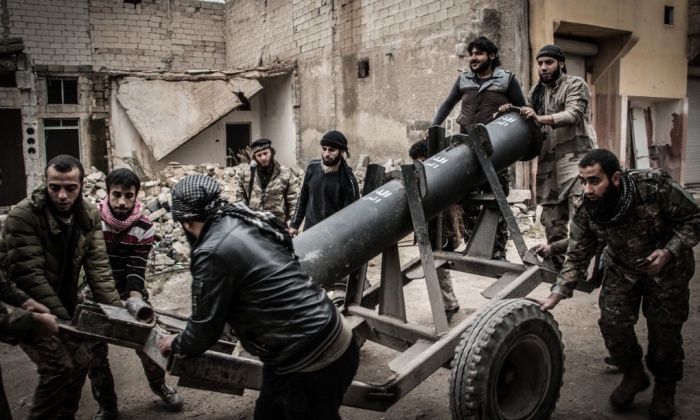
A Friday round-up of what happened and what’s been written in the world of war and military/security affairs this week. It’s a mix of news reports, policy briefs, blog posts and longform journalism.
- Al-Shabaab massacred 36 non-Muslim quarry workers in Kenya.
- The International Criminal Court has set a deadline for prosecutors in the case against Kenyan president Uhuru Kenyatta.
- Kenyan police say they have cracked a cybercrime center run by Chinese nationals in Nairobi.
- The US has warned South Sudan that sanctions may be on their way for those threatening peace in the new country.
- France’s commander in the Central African Republic, Gen. Éric Bellot des Minières, says security is improving.
- Egypt’s public prosecutor is appealing the verdict clearing former president Hosni Mubarak of the killing of protesters in 2011.
- A judge sentenced 185 Muslim Brotherhood supporters to death for an attack on a Cairo police station last year.
- ISIS is reportedly setting up training camps in Libya.
- Activists say that ISIS is now attacking Syria from positions inside Turkey — a claim denied by the Turkish government.
- Al-Qaeda in the Arabian Peninsula has threatened the lifeof hostage American photographer Luke Somers in a recent video. Somers has been held in Yemen for over a year, and a recent American rescue mission failed to retrieve him.
- Saudi Arabia has suspended aid to Yemen.
- The Iranian air force bombed ISIS targets in Iraq.
- What has driven hundreds of young Germans to join the Islamic State?
- 12 reporters from DIE ZEIT and German public television news magazine report München investigated the Islamic State’s finances and found the group wealthy but the caliphate’s economy poorly managed and failing.
- A new Brookings report profiles the Islamic State.
- A French charity is suspected of being a front for financing Syrian terrorism.
- The Syrian war’s death toll now tops 200,000.
- The World Food Program has had to suspend aid to 1.7 million Syrian refugees as a result of a funding crisis.
- Syrian rebels trained by the US will undergo rigorous screening — stress tests, psychological evaluations, background checks and biometric data collection.
- The UN has begun an investigation of Israeli strikes that hit UN facilities in Gaza this summer.
- Israel will conduct early elections.
- Lebanon detained the wife and daughter of Islamic State leader Abu Bakr al-Baghdadi.
- A corruption investigation revealed the Iraqi army had 50,000 “ghost soldiers” on its payroll. Iraqi Prime Minister Haider al-Abadi fired 24 senior Interior Ministry officials as a result.
- Air Force pilot Captain William Dubois has been named as the third American to die in Operation Inherent Resolve. He was killed when his F-16 crashed as a result of maintenance problems.
- US airstrikes in eastern Afghanistan over the past two weeks have been aimed at the senior leadership of the Pakistani Taliban.
- Kabul’s police chief, General Zahir Zahir, has resigned his post with no public explanation. His resignation comes after an upsurge in Taliban attacks in the capital.
- A new International Criminal Court prosecutor’s reportpushes the court closer to a legal confrontation with the United States over the war in Afghanistan.
- Maoists killed 13 members of India’s Central Reserve Police Force in Chhattisgarh on Monday.
- The Ukrainian military and separatist rebels have agreedto a temporary truce at the Donetsk airport.
- NATO is struggling to set up a rapid reaction force to deal with Russia.
- Militants and government forces clashed in the Chechen capital of Grozny. The gun battle left 20 dead.
- Russia admits that it is headed toward a recession.
- Kalashnikov — the Russian gun manufacturer — gets a brand overhaul.
- WIRED interviews the Russian dark web drug lord known online as Darkside.
- A report from the Center for New American Security looks at Chinese cybersecurity strategy.
- “By accident and by design, mortars mostly kill civilians.” A new report from Action on Armed Violence examines the data on the impact of manufactured explosive weapons — calling mortars the worst of them. 92% of their casualties are civilian.
- A look at the militarization of police around the world.
- The next US secretary of defense will be Ashton Carter.
- The US Army is recognizing the real names of two transgender veterans and has changed the gender status on their discharge documents, which will allow them to receive their benefits.
- Northwestern’s Medill School of Journalism has renamed their Medill Medal for Courage after James Foley. The medal, awarded to a journalist every year for courage in pursuit of a story, was awarded to Matthieu Aikins this year.
- Inside the debate over the release of the CIA torture report.
- The House passed the FY2015 defense authorization bill. It goes to the Senate next week. Here are some key provisions.
 Hiba's curmudgeonly musings about books, politics & other trifles.