
- Political detainees in Egypt are dying of neglect in prison, being refused life-saving medical treatments.
- Egypt’s young activists are disappearing into Egypt’s detention system, taken off the streets by plainclothes security forces.
- The US sent more troops to Sinai to boost the security of the peacekeeping operation.
- Human rights violations are escalating in the Congo ahead of elections.
- Human Rights Watch says a government militia in Darfur is guilty of mass rapes and killings of civilians over the past two years.
- The South Sudanese parliament unanimously voted to approve a peace deal to end fighting between President Salva Kiir and his former deputy Riek Machar.
- Former Chadian dictator Hissene Habre was forcibly dragged into Senegalese court for the resumption of his war crimes trial.
- Guinea-Bissau’s prime minister announced his resignation after two days in office.
- Elections in the Ivory Coast next month are being preceded by violent clashesbetween protesters and police.
- Two people were killed in a grenade attack in the Central African Republic’s capital.
- Burundi’s army chief survived an assassination attempt in the capital, Bujumbura.
- The Pope will visit Kenya, Uganda and the Central African Republic in November.
- A resident of the Libyan city of Derna chronicled months of terror as Al Qaeda and the Islamic State battled for control.
- Mali has arrested three suspected militants in connection with attacks on the UN and police and threats to journalists.
- Turkey and the Kurds are trading fatal blows.
- Palestine won approval to fly their flag in front of UN headquarters.
- The US Treasury Dept sanctioned Hamas officials.
- The Saudi-led coalition fighting in Yemen may be setting its sights on a ground offensive on Sana’a.
- Yemen peace talks are set to resume next week.
- Russia lifted objections to a UN probe into culpability for chemical weapons attacks in Syria.
- Russian forces are now participating in military operations in Syria, according to a Reuters investigation.
- Government forces in Syria have killed more people this year than the Islamic State has.
- Al Nusrah Front, an Al Qaeda affiliate in Syria, claims it has taken a Syrian regime air base in Idlib.
- The Islamic State is advancing on the Deir al-Zour military base in Syria.
- Footage of coalition airstrikes shows the destruction of an Islamic State operating base/staging area near Ramadi.
- The battle to retake Ramadi is still pretty slow-going.
- Australia will join in airstrikes against the terror group.
- The Islamic State has published images of two hostages: a Chinese national named Fan Jinghui and a Norwegian graduate student named Ole Johan Grimsgaard-Ofstad.
- A senior Iraqi Justice Ministry official was kidnapped in a daytime ambush.
- 11 officers in Afghanistan’s counternarcotics police force were killed in a “friendly fire” airstrike in the Garmsir district of Helmand.
- The Dutch government says an aid worker kidnapped in Afghanistan in June has been released after 81 days.
- The Taliban’s leadership struggles may be a recruitment boon for the Islamic State.
- Terrorist attacks have been significantly reduced in Pakistan this year.
- Pakistan used drone technology in combat for the first time, killing three militants in a strike in the Shawal Valley in the country’s northwest.
- Pakistan is intimidating and harassing refugees into returning back to crisis in Afghanistan.
- 12 people have been convicted and face the possibility of the death penalty for the July 2006 bombings of seven Mumbai commuter trains. 188 people died and 800 were injured.
- The militant group Abu Sayyaf is the first to be designated a terrorist organization by the Philippines.
- A man has been given more than two years in prison by a Russian court for painting a star in Ukrainian colors on a skyscraper in Moscow.
- Russia is building a large military base near the Ukrainian border.
- A summit will be held in Paris in October over the crisis in Ukraine.
- Some Belarusian opposition activists are rallying against the October election in which Alexander Lukashenko, “Europe’s last dictator,” looks set for re-election.
- Countries in Europe, as well as the US and Australia, have upped the number of refugees they will take in as streams of people displaced by violence travel long and dangerous journeys to find some safety.
- Europe has another refugee crisis: the 2 million people displaced by conflict from their homes in eastern Ukraine.
- For the first time, a Serbian court has charged eight people in connection with the Srebrenica massacre.
- The Guardian reports “highly unusual” and frequent contact between Director of National Intelligence James Clapper and a military intelligence officer currently implicated in the inquiry into whether or not intelligence assessments about the war on the Islamic State were manipulated.
- There is concern that the CIA may have abandoned a lead that could have lead to Al Qaeda hostage Warren Weinstein (killed in a US airstrike in January) because the agency prioritizes hunting terrorists.
- Two murders have sparked a political crisis in Northern Ireland.
- Talks in Northern Ireland over power-sharing will include the possibility of bringing back a ceasefire monitoring body.
- British authorities say the number of people being arrested on suspicion terrorism involvement is at a record high.
- Venezuelan opposition leader Leopoldo Lopez is jailed for nearly 14 years for “inciting violence” during last year’s protests.
- The drug war heats up in the Caribbean.
- Senate Democrats blocked a Republican effort to kill the Iran deal.
- An article of mine for VICE News – “If the US Won’t Sell You Weapons, France Might Still Hook You Up.”
4th September 2015
- A militant group in Mali/the Sahara called Al Murabitoon (loyalty: Al Qaeda) has released a video showing a Romanian hostage.
- Seven militants suspected of attacking the Malian military have been arrested in the Ivory Coast.
- Libya banned Yemenis, Iranians and Pakistanis from entry to the country.
- Boko Haram gunmen on horseback killed 79 people in three attacks in northeastern Nigeria earlier this week.
- A double suicide bombing in northern Cameroon killed 19 and wounded 143.
- Chad executed ten members of Boko Haram after they were found guilty of involvement in a double attack that killed 38 in the capital, N’Djamena.
- Al Shabaab attacked an African Union base in southern Somalia.
- Zimbabwean dissident Itai Dzamara demonstrating against Mugabe’s presidency was seized March 9th and hasn’t been heard from since.
- Egypt, without a parliament since June 2012, has announced a two stage parliamentary election for October and November.
- Egypt sentenced three Al Jazeera journalists to three years in prison.
- Two explosions on the Sinai peninsula on Thursday wounded four US troops and two international peacekeepers.
- Militant attacks across Egypt are growing more brazen.
- Hamas is and has been on the outs with Iran, making it unlikely the group will receive much benefit from the nuclear deal.
- Two local workers for the Red Cross were shot dead as they drove through the northern Yemeni province of Amran.
- An Islamic State suicide bombing and car bombing at a mosque in Sana’a, Yemen killed 20 people.
- The war in Yemen has granted opportunity to militants like Al Qaeda and the Islamic State, both growing their presence in Aden.
- The Islamic State blew up three ancient tower tombs in the Syrian city of Palmyra, all dating to between 44 AD and 103 AD.
- The group also announced their own currency – the Gold Dinar.
- Russia may be increasing its involvement with Assad. It is also delaying a UN investigation to assign blame for chemical weapons attacks in Syria.
- Cluster munitions have been used in five countries this year: Libya, Sudan, Syria, Ukraine and Yemen.
- What they carry: here’s what Syrian refugees bring with them on their treacherous journey and why they do it.
- Canada has charged Syrian intelligence officer George Salloum over the torture of Maher Arar, a Canadian engineer rendered to Syria after being mistaken for a terrorist in 2002.
- Civilian deaths have been linked to 71 separate air raids in the coalition bombing of the Islamic State.
- Turkish jets took part in those coalition strikes on Syria for the first time over the weekend.
- The CIA and JSOC have been conducting drone strikes over Syria in their own separate offensive against the Islamic State.
- Turkey released two VICE reporters arrested last week.
- The New Yorker looks at what happens to former jihadists.
- The battle to retake Ramadi moves at a glacial pace.
- 17 Turkish workers and their Iraqi translator were abducted by masked gunmen from their construction site in Baghdad.
- The US reopened a criminal investigation into the deaths of 18 Afghan civilians, reportedly killed by a US Special Forces A-Team over the course of 2012 and 2013.
- The desertion rate is climbing in Afghan security forces.
- Corruption in Pakistan allows jihadists to obtain ID cards.
- Ali Larijani, the speaker of Iran’s parliament, has suggested the possibility of a prisoner swap for jailed Washington Post reporter Jason Rezaian.
- Clashes between Indian and Pakistani troops left 11 civilians dead last weekend.
- Malleshappa Madivalappa Kalburgi, an Indian secular scholar, was fatally shotlast weekend. This is third killing of a secular scholar in India since 2013.
- The Islamic State’s “province” in the Caucasus has claimed their first attack against the Russian Army, making their move in southern Dagestan.
- Uzbekistan banned political science from being taught in universities.
- Chinese attorney Zhang Kai, detained in August over his representation of churches battling the government’s push to take down crosses, could be chargedwith spying.
- China seeks to modernize its military, cutting 300,000 soldiers to shift resources from land forces to sea and air capabilities.
- China commemorated the 70th anniversary of the defeat of Japan in World War II with massive parades (and one company made Hideki Tojo ice creams).
- Protests outside Ukrainian parliament on Monday left one national guard member dead and 100 people injured as nationalists opposing the eastern separatists were enraged by a bill granting more powers to Luhansk and Donetsk.
- NATO opens new command units in Eastern Europe.
- The US sanctioned Russian state arms export agency Rosoboronexport and others.
- Neo-Nazi/right wing extremists and arson attacks on asylum hotels are a growing concern in Germany.
- Germany is also making efforts to welcome refugees – greeting them at the train station in Munich with chocolate.
- Refugees stuck at the Keleti train station in Budapest are vowing to walk to Austria.
- Britain will now take in “thousands” of refugees.
- The rate of former Guantánamo detainees returning to violence has lowered, according to intelligence reports.
- President Obama has secured the votes required to ensure passage of the nuclear deal.
- Is a “Guantánamo North” in the works?
- Army Ranger School is officially open to all soldiers regardless of gender.
28th August 2015
- Two separate car bombings in Somalia last Saturday killed at least 21 people combined.
- As many as 200 people died when a boat carrying refugees capsized a kilometer off the Libyan port city of Zuwara.
- More on Ibrahim Halawa, the Irish teenager facing a mass trial in Egypt.
- Dissent grows in Eritrea.
- 14 were arrested in Morocco and in Spain on suspicion of recruiting for the Islamic State.
- A shortage of funds has caused the UN to cut aid to former rebels in the Congo.
- Researchers examine the challenges to justice in sexual violence cases post-conflict in Sierra Leone, Kenya, Uganda and Liberia.
- Egypt is in talks to buy two warships from France (the ones originally intended for Russia).
- The UN will investigate a government-allied militias role in breaking with the peace accord in Mali this month.
- There is quiet optimism about the peace deal signed in South Sudan.
- The UN points to the flow of weapons into South Sudan as a key factor in the violence this deal seeks to end.
- The Islamic State may have used mustard gas last week in northern Syria.
- The UN has set out a plan for an inquiry to assign blame for chemical weapons attacks in Syria.
- The Islamic State has also released a video of the destruction of the ancient Baalshamin temple in Palmyra.
- Here are images of Palmyra in all its glory taken in the late 1800s.
- The FBI has warned art dealers about purchasing antiquities and artifacts from the Middle East over concerns they might be sourced to Islamic State looting.
- Jameel Raadoun, a Free Syrian Army commander, was killed in a car bombing in Antakya, Turkey.
- A Birmingham-born hacker for the Islamic State was killed in a strike in Syria.
- Protesters in Lebanon clashed with police over the ongoing garbage crisis, as well as wider issues of political corruption.
- A federal judge in Manhattan ruled that the Palestinian Authority had to post a $10 million bond in the high-profile terror case over six attacks in Israel that also killed Americans.
- Palestinian President Mahmoud Abbas stepped down as head of the PLO’s Executive Committee to force elections.
- In response to a rocket attack launched from the Gaza Strip, Israel launched a strike on a Hamas facility.
- The UAE freed a British hostage held by Al Qaeda in Yemen.
- Troops in the Saudi-led coaltion are accused of using cluster bombs in Yemen.
- An explosion in the parking lot of a Baghdad police station today (Friday) killedsix people.
- A 114-pg Iraqi parliamentary report on why the Iraqi army failed to hold back the Islamic State last summer has revealed that the top army officer for Mosul remained on vacation despite warnings about the terror group. It also points to the fact the army was underfunded and under-equipped, full of internal rivalries and frequent desertions.
- An Islamic State suicide attack on military headquarters in Anbar killed two senior Iraqi generals.
- The US says that IS second-in-command Hajji Mutazz was killed in an airstrike.
- The New York Times reports that intelligence assessments of US progress in Iraq may have been purposely skewed.
- A Kurdish offensive won ten villages from IS in northern Iraq.
- Executions in Iraq’s Kurdish region draw criticism from the UN.
- Two gay men from Iraq and Syria made history by being the first to testify to the UN Security Council on LGBT persecution.
- Iran may have built an extension on its Parchin military site.
- A mass trial of 41 accused extremists opened in the UAE.
- A satirical Facebook page targeting Afghanistan’s politicians is driving the Afghan government crazy as they try to find out who’s behind it.
- Two US troops were killed in a green on blue attack on a base in southwestern Helmand province.
- The Musa Qala district of northern Helmand fell to the Taliban this week, more a propaganda victory for them than a strategic one.
- Spiegel interviews former Afghan intelligence chief Amrullah Saleh.
- Two Central Asian jihadist groups –– the Islamic Movement of Uzbekistan and the Islamic Jihad Union –– have rifted over whether to support Al Qaeda or the Islamic State.
- A decade from now Pakistan’s nuclear arsenal could be the third largest in the world, says a new think tank report.
- Khalid Sheikh Muhammed’s nephew was reportedly killed in a raid in Karachi carried out by Pakistani intelligence.
- Nine civilians were killed and 63 wounded today (Friday) as Indian and Pakistani border guards exchanged fire in Kashmir.
- The US backed Sri Lanka’s war crimes probe, having initially pushed for an independent one.
- Ukraine’s creditors agreed to forgive a portion of the country’s debt.
- The government and separatists have agreed to stop all truce violations (a ceasefire, but for real) starting September 1.
- Ukraine says 7 troops were killed in recent days.
- A Russian court sentenced Crimean filmmaker Oleg Sentsov to twenty years in prison over terror charges.
- Naser Oric, a Bosnian Muslim wartime commander, was indicted for war crimes over the killings of three Serbian prisoners of war near Srebrenica in 1992.
- The Washington Post maps the walls being built across Europe as barriers to migrants. (Or is it more correct to refer to them as refugees?)
- The migration crisis remains a serious concern across Europe – 70 or more refugees were found dead in a truck abandoned on the expressway between Vienna and Budapest.
- Austria, the first Western European country that refugees come to on their long and arduous journeys, has become central in the current crisis.
- A gunman’s attack on a train from Amsterdam to Paris was foiled by some on board, including three Americans. Security experts say there is not much that can be done to boost security procedures on these high volume rail lines.
- Japan’s Yamaguchi-gumi mafia group seems on the brink of a split, and police are bracing for a gang war.
- Seoul and Pyongyang ended a upsurge in tensions and mutterings about the possibility of war with a deal.
- A Chinese journalist was jailed for coverage of the stock market crash.
- A border dispute heats up between Colombia and Venezuela.
- Mexican President Enrique Pena Nieto replaced his national security chief and his foreign relations secretary.
- Only three of 116 men who remain imprisoned at Guantánamo were captured by US forces.
- The push to give the Pentagon primacy in the drone war continues.
- Leaked email exchanges from two companies, Israeli and Italian, show their state surveillance partnerships.
- Police in North Dakota are cleared to use drones armed with “less than lethal” weapons like tasers or tear gas.
21st August 2015
- Egypt has passed harsh new counterterrorism legislation receiving global condemnation from human rights groups.
- An early morning Islamic State car bomb hit a police headquarters in Cairo Thursday, resulting in many injuries but no fatalities. In Egypt, the group has waged war for two years on authorities but avoided civilian targets.
- New sex abuse allegations have been leveled at the UN mission in the Central African Republic.
- South Sudanese President Salva Kiir will sign a peace deal after initially refusing.
- The US has proposed a UN arms embargo on South Sudan.
- Convicted Congolese warlord Thomas Lubanga has appealed for early release.
- As many as 60 were killed in a Boko Haram raid on a northeastern village.
- Former Burundian army chief Col. Jean Bikomagu was assassinated Saturday. The UN is warning the country’s situation is about to “spiral out of control” and the African Union said the country’s crisis represents a “catastrophic” risk to the rest of the region.
- Amid all this, Burundi’s President Pierre Nkurunziza, the focal point of all this unrest, was sworn in for a third term.
- After clashes in northern Mali between pro-government forces and Tuareg rebels, the UN has set up a “security zone.”
- The coastal Libyan city of Sirte has fallen to the Islamic State.
- The Yemeni port city of Hodeida was hit with airstrikes, a crucial port for humanitarian aid supplies.
- Rebels have lost control over some parts of Yemen, leaving behind opportunity for Al Qaeda. Factions in the Saudi coalition have also started to turn on one another.
- Amnesty International says all sides in the conflict in Yemen have committed war crimes.
- The Red Cross is conducting workshops on the laws of war for Hamas militants in Gaza.
- Palestinian prisoner Mohammed Allan ended his 66-day hunger strike after Israel’s Supreme Court suspended his detention.
- Israel retaliated after rockets hit along the Lebanese border, launching return fire into the Syrian Golan Heights.
- Lebanese Salafist Imam Ahmed al-Assir was arrested by security services after two years on the run for involvement in the deaths of 17 soldiers.
- This week marked a full year since we first learned of the execution of journalist James Foley by his Islamic State captors. Watch some of his best journalistic workhere.
- The Islamic State beheaded an 82-year-old scholar and archaeologist – Khaled al-Asaad, the head of antiquities at the Syrian historic site of Palmyra – after he refused to lead them to the whereabouts of protected artifacts.
- The weapon killing the most Syrians is the government’s hideous and indiscriminate barrel bomb. An airstrike on a market in Douma killed about 100 people – one of the bloodiest single incidents in a horrifically bloody war.
- Defeating the Islamic State is taking precedence over ousting Assad.
- The Islamic State overran an Iraqi military base in Fallujah.
- There is credible evidence that the group used mustard gas in an unspecified attack on Kurdish forces. It could have obtained the chemical agent from Syria.
- An American fighting for the Islamic State detonated himself in the Iraqi city of Baiji – he is the third known American suicide bomber for the group.
- How does the Islamic State appeal to teenagers like the three girls who abandoned London for the terror group?
- Spiegel profiles a Dutch teenager who spends his time mapping the Islamic State.
- Will McCants breaks down how the Islamic State upped the ante on Al Qaeda,outdoing them in terror.
- Britain and Iran will reopen their embassies.
- The Wall Street Journal is hitting back at Iranian state media accusations that the paper and veteran correspondent Farnaz Fassihi acted as go-betweens for the US and the Green Movement in 2009.
- The audio cassette tapes salvaged from a Kandahar compound vacated by Bin Laden back in 2001 include extensive sermons, speeches and recordings of battles.
- Al Qaeda’s emir Ayman al-Zawahiri has offered bayat (allegiance) to the new Taliban leader Mullah Akhtar Mohammed Mansour, preserving the longstanding relationship between the two groups.
- Former warlord and current Afghan VP Abdul Rashid Dostum raised his own private collection of militias to fight the Taliban offensive in the north this summer after failing to convince the National Security Council to act.
- A probe shows that Camp Belambai where Army Staff Sgt. Robert Bales served prior to murdering 16 Afghan civilians had a lax atmosphere and “low standards of personal conduct and discipline.”
- The family of Maj. Gen. Harold Greene, the highest ranking American to have been killed in a green on blue attack, are unsatisfied with an Army investigation’s conclusion that there was no negligence and no way to have prevented the attack.
- A faction of the Pakistani Taliban assassinated a provincial minister in Punjab as retaliation for the killing of Lashkari-e-Jhangvi leader Malik Ishaq.
- Bangladesh has made three arrests in the gruesome murders of secular bloggers.
- A bomb attack in Bangkok killed 20 people. Thai police say they believe at least 10 people were involved in the plot.
- North and South Korea exchanged fire at the border.
- It has been 75 years since the assassination of Leon Trotsky.
- Earlier this week nine people died in an exchange of heavy artillery fire between Ukrainian forces and pro-Russian rebels.
- 8000 Ukrainian soldiers have defected to the separatist side since fighting began.
- A former Kremlin hired online troll won symbolic damages of 1 ruble in her suit against her former employer over the Internet propaganda “factory.”
- Wikipedia will likely be banned in Russia.
- An Estonian police officer, detained by Russia last year, has been given 15 years in prison for espionage.
- Germany charged a former member of the BND intelligence agency with treasonfor allegedly passing information to the US and Russia.
- Azerbaijan sentenced prominent human rights activist Leyla Yunus to 8 and ½ years on a variety of charges. Her husband was sentenced to 7 years. The convictions have been decried as politically motivated and repressive.
- Politico profiles Minneapolis city councillor Abdi Warsame, the only Somali-American elected to the council, and his struggles to prevent the Islamic State from making inroads in his community.
- Defense lawyers for Dzhokhar Tsarnaev have requested a new trial outside of Boston.
- The security firm that vetted Edward Snowden has settled with the DOJ for $30m after claims it made shortcuts in federal employee background investigations.
- Two women made history by graduating from the notoriously difficult Army Ranger School: 1st Lt. Shaye Haver and Capt. Kristen Griest.
- The Navy is now indicating that it will open up SEAL training to women as well.
7th August 2015
- Burundian general Adolphe Nshimirimana, considered the regime’s number two, was assassinated in the capital Bujumbura on Sunday.
- Pierre Claver Mbonimpa, a Burundian human rights activist involved in opposition to Pierre Nkurunziza’s presidency survived an assassination attempt this week.
- The role Burundi’s troops play in peacekeeping efforts in Somalia hamper the African Union’s ability to deal with the country’s political crisis.
- Nighttime has become terrifying in Bujumbura.
- Boko Haram fighters killed nine people and kidnapped others in attacks on Cameroonian villages along the border with Nigeria.
- Nigerian troops freed 178 Boko Haram captives.
- A UN peacekeeper was killed in clashes in the Central African Republic’s capital city, Bangui.
- Warring South Sudanese factions led by Salva Kiir and his former deputy/current nemesis Riek Machar resumed peace talks Thursday.
- The Ivory Coast set the date for presidential elections at the end of October.
- An attack near the city of Timbuktu left ten Malian soldiers dead. It was laterclaimed by Al Qaeda in the Islamic Maghreb (AQIM).
- British police say there are strong links between the terror attack at Tunisia’s Bardo Museum and the more recent one at the beach in Sousse.
- Efforts to stabilize Libya after the civil war show the limits of American abilities and weakness of Libyan institutions.
- Clashes after last week’s extremist arson attack that left a Palestinian toddler dead led to another death – Palestinian teen Laith Khaldi was shot in the chest by Israeli forces near a checkpoint and later died of his wounds.
- A suicide bomber detonated at a mosque in Saudi Arabia near the Yemeni border Thursday, killing more than a dozen.
- Loyalists retook the al-Anad military base in Yemen.
- Emirati troops have joined in the fight against the Houthis.
- A French woman abducted in Yemen in February has been freed.
- An aid worker for Doctors Without Borders recounts “horror after horror” in Yemen.
- Shiite militias with terrible human rights records battle the Islamic State in Iraq.
- A minibus bombing in the Shiite neighborhood of Baghdad currently known as Sadr City killed seven.
- The US has transferred custody of Umm Sayyaf, an Iraqi detained during a raid in the fight against the Islamic State, to the Kurds.
- The Islamic State tightens its online security measures.
- Human rights monitors say that bombings under the US-led coalition have led toat least 459 civilian deaths in 52 specific airstrikes. Only two non-combatant deaths have officially been acknowledged.
- The first of US-trained Syrian fighters is believed to have been killed in combat.
- The US expanded economic sanctions on Syria.
- Civilian casualties in Afghanistan are at their highest since 2009.
- A massive truck bomb in Kabul this morning (Friday) killed eight people and injured as many as 400 others.
- The new Taliban leadership is allied with Al Qaeda.
- Reports that Jalaluddin Haqqani has also been dead for awhile have been denied. A letter attributed to him has been released endorsing the new Taliban leadership.
- A suspected US drone strike killed four militants in Datta Khel, North Waziristan, near the Afghan border.
- Two soldiers and a suspected rebel were killed in a convoy ambush in Indian-controlled Kashmir.
- Four Ukrainian soldiers were killed in the lead-up to new talks over the ceasefire.
- Cossacks face reprisals in the form of mysterious ambushes in eastern Ukraine.
- The US imposed new sanctions on Russia.
- Former Russian army commander Vladimir Chirkin is facing up to 7 and half years in prison for bribery.
- Spiegel interviews Mikhail Gorbachev.
- How the fall of the Soviet Union altered the world’s forests.
- An archaeological museum in Crimea proves to be a battleground over history, identity and “Russianness.”
- Optimism and skepticism in the long slog towards peace in Colombia.
- Violence against the press escalates in Mexico.
- The murder rate has skyrocketed in El Salvador after a truce between gangs and the government broke down earlier this year.
- Two women are currently making their way through the third and final swamp phase of Army Ranger School.
- Radical preacher Anjem Choudary has been charged in Britain under the 2000 Terrorism Act for supporting the Islamic State.
- Japan is marking the 70th anniversary of the American bombings of Hiroshima (August 6th) and Nagasaki (August 9th) – which combined killed more than 200,000 people.
- Eyewitness testimonies describe the bombs’ horror and the experience of surviving.
- The bureaucracy of the decision to bomb Hiroshima and Nagasaki.
- How the Japanese press reported the destruction of the atomic bomb.
- The story of the Times reporter who witnessed the lead-up to the bombing.
July 24th, 2015
- Three bomb blasts at a mosque and a bus station in Gombe, northern Nigeria on Wednesday killed 37 and injured many more.
- Boko Haram’s devastations in northeastern Nigeria have forced tens of thousands across the border into the Diffa region of Niger, creating a humanitarian crisis.
- The Nigerian president has accused the US of aiding Boko Haram by refusing to arm Nigeria.
- A double suicide bombing by two teenage girls in northern Cameroon killed more than 20.
- The trial in Senegal for crimes against humanity of former Chadian dictator Hissène Habre, a landmark trial representing years of effort by victims and their families, has been adjourned til September.
- Tunisia cracks down on mosques after the Sousse tourist massacre.
- Across North Africa and the Middle East, boundaries and borders are fortifiedagainst the threat of militancy.
- Four Italian construction workers have been kidnapped in Libya.
- Refugees return home to the Central African Republic to face poverty and contaminating drinking water.
- A UN human rights official has resigned over the CAR sexual abuse case.
- Malian troops destroyed two militant camps near the border with the Ivory Coast.
- Somali troops have captured a southern town away from Al Shabaab.
- Human Rights Watch says the South Sudanese government has committedhorrifying war crimes – killing civilians, gang-raping and burning villagers alive and pillaging property – in the military offensive in Unity State.
- A cultural center in the Turkish town of Suruc, near Kobani, was hit by an Islamic State suicide attack. More than thirty left-wing activists were killed.
- Turkey has now agreed to let American warplanes use the Incirlik air base in the country’s south to launch attacks on the Islamic State.
- Turkish jets struck their first Islamic State targets inside Syria early this morning (Friday).
- Al Qaeda member and Khorasan group leader Muhsin al-Fadhli was killed by a US airstrike in Syria earlier this month.
- Three Spanish freelance journalists and one Japanese freelancer are missing in Syria, feared kidnapped.
- Iraqi forces prepare for an offensive against the Islamic State in Ramadi.
- The Iraqi town of Haditha has been an “outpost of resistance” against the Islamic State for a year and a half, but supplies are running low.
- The Islamic State executed Iraqi journalist Jala al-Abadi in Mosul.
- A car bomb last Friday in the Iraqi town of Khan Bani Saad killed over 100 people, one of the country’s deadliest attacks in a decade.
- Aidan Morrison takes apart the US “cockroach approach” to fighting the Islamic State.
- As the Islamic State gains and holds territory and solidifies control, it transformsfurther into a state that uses terror as a means of control.
- Washington Post journalist Jason Rezaian has now spent over a year detained in Iran.
- How Iranian state media prepared for the nuclear deal.
- Iran has put 694 people to death this year.
- The second round of talks between the Afghan Taliban and the Afghan government are set for July 30 in China.
- A suicide bomber at a market in northwestern Afghanistan on Wednesday killedover a dozen.
- The US says that senior Al Qaeda commander Abu Khalil al-Sudani was killed in an airstrike in Afghanistan earlier in July.
- Afghan forces are struggling against rising casualty rates to maintain a stalemate. They are launching massive counterterrorism operations across the country.
- Peace talks between the government of Myanmar and rebel leaders ended today (Friday) with no cease-fire agreement.
- A UK privacy advocacy group says that Pakistan is working on a mass surveillance system meant to tap the phones and emails of hundreds of millions worldwide.
- Kyrgyzstan is renouncing a 1993 bilateral agreement with the United States.
- A former prisoner from Donetsk, who was jailed while the region was still under Kiev’s control, talks about how life in prison changed after the separatist takeover.
- A Russian town on Ukraine’s border is abuzz with military buildup (and spiking crime). Life in eastern Ukraine remains on edge despite the ceasefire.
- Chechens fight on both sides in Ukraine.
- The MacArthur Foundation, threatened with being labeled undesirable, isshuttering its Moscow offices.
- The ongoing public inquiry into the murder of Alexander Litvinenko resumes today: here’s what we know and don’t know yet.
- Celebrations in China over the 70th anniversary of the end of WWII expose the continued rifts with Japan.
- Nine tourists are being deported from China for watching “terrorist” videos.
- The US has decided against publicly blaming China for the massive breach of sensitive data held by the Office of Personnel Management.
- North Korea may be prepping for an October long-range rocket launch.
- Spiegel interviews Julian Assange.
- How the Chattanooga shooting unfolded.
- Charleston shooter Dylann Roof has been charged with federal hate crimes.
- A Pentagon investigation into those live Anthrax samples blames procedure but won’t admit human error.
- An audit shows that the computer system used by the US Treasury to track foreign threats is vulnerable to hacking.
- A US Navy nurse who refused to participate in force-feeding at Guantánamo has been been given an ethics award by the American Nurses Association.
- Efforts to close the prison are going about as badly as they always have.
- Canada’s new anti-terror legislation is raising concerns in the UN.
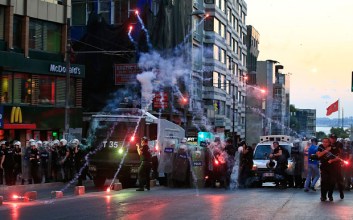
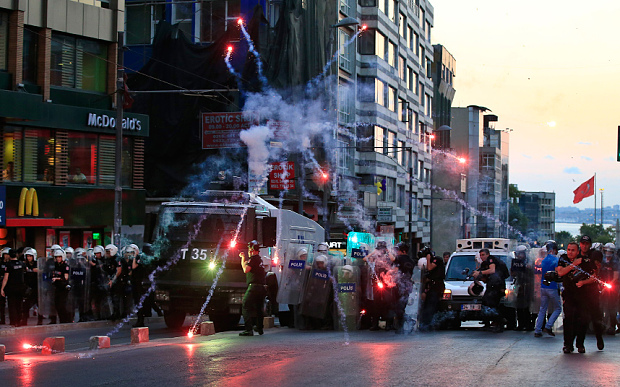
Turkish protesters launch fireworks at a demonstration to denounce a suicide bombing in Suruc. AP.
17th July
- A pair of explosions on Thursday killed at least 49 people in the northeastern Nigerian city of Gombe. And this morning (Friday), explosions have targeted Eid prayers in Damaturu, killing two.
- 12 were killed in Boko Haram attacks inside Niger as well.
- Nigerian President Buhari fired his army, navy, air force and defense chiefs on Monday.
- Two senior al-Shabaab commanders have reportedly been killed in a drone strike.
- Following attacks by two veiled suicide bombers, Cameroon has banned the burqa.
- A man disguised by a burqa carried out a suicide attack that left 15 dead in the Chadian capital of N’Djamena over the weekend.
- Burundi’s presidential elections have been postponed until July 21 over security concerns.
- A Tunisian leader of an Al Qaeda-linked militant group (Okba Ibn Nafaa Brigades) has been killed.
- 20 suspected militants have been detained in Mali. Two are French citizens.
- Six Muslim Brotherhood supporters were killed in clashes with police this Friday in Cairo.
- The first American-trained Free Syrian Army fighters headed back to Syria to fight.
- Leaked documents show that Israeli special forces were responsible for the 2008assassination of Syrian Brig. Gen. Mohammed Suleiman at a beach resort in Tartous.
- A car bomb at a checkpoint near Saudi Arabia’s Ha’er prison has been claimed by the Islamic State. The group also took credit for a rocket attack on an Egyptian naval vessel off the coast of Sinai.
- One person died in an Islamic State car bombing outside the Italian consulate in Cairo.
- New Wikileaks documents show the extent of Saudi Arabia’s efforts to undermineIran.
- Yemen’s VP-in-exile says that Aden has been retaken from Houthi forces.
- A Spiegel journalist interviews Abu Abdullah, the man formerly responsible for organizing Islamic State suicide attacks, in his prison cell in Baghdad.
- Iraq has launched an offensive against the Islamic State in Anbar province.
- Celebrating Ramadan in the Islamic State’s caliphate.
- Nearly 15000 civilians have been killed in Iraq over the last 16 months.
- A nuclear deal has been struck with Iran – here’s how the last 17 day round ofnegotiations played out.
- A UN Security Council vote is scheduled for Monday on a resolution to back the Iran deal.
- A third closed-door court session has been held in the case of Jason Rezaian, theWashington Post reporter held in Iran.
- Afghan Taliban leader Mullah Omar has backed peace talks.
- American airstrikes increase in Afghanistan.
- Five civilians are dead in exchanges of fire between India and Pakistan in Kashmir. Both accuse the other of firing unprovoked.
- New footage has emerged of Russian-backed separatists going through the wreckage of the downed passenger flight MH17 a year ago.
- A Dutch-led investigation will all but certainly place blame on those same separatists for the plane’s demise, and Russia is fighting calls for a tribunal.
- A string of Russian military aircraft accidents are attributable to under-qualified pilots and a increased operational tempo.
- A land dispute is heating up between Russia and Georgia over South Ossetia. Georgia is accusing Russia of violating their sovereignty by placing border markers at the edge of the contested territory.
- China’s hackles are raised over Japan’s new security bill.
- Four Marines were shot dead in a shooting spree in Chattanooga, TN. The motivations of the deceased suspect, Mohammed Yousef Abdulazeez, remain unclear.
- A failure in the FBI’s background check process allowed accused Charleston gunman Dylann Roof to purchase a gun despite a previous arrest for narcotics possession.
- The American Psychological Association colluded with CIA and Pentagon officials over the torture program.
- Emergency surveillance measures introduced in the UK last year have been ruled unlawful.
- Afghans who grew up in the UK now face deportation.
- A surge in migrants escaping Syria, Iraq and Afghanistan have created tensionson the Serbia-Hungary border.
- Canada is no longer a haven for soldiers opposed to war.
- Auschwitz guard Oskar Gröning was convicted on 300,000 counts of accessory to murder and sentenced to 4 years in prison. Here is how he avoided prosecution 70 years earlier.
- The Islamic State forces tech companies into a dilemma over free speech vs. security.
- Belfast’s police clashed with parade demonstrators in the often-inflammatory 12th of July loyalist parades this year.
- What Northern Ireland can teach us about terrorism today.
10th July
- Egypt ramps up the campaign against militants in Sinai, while threateningjournalists over coverage.
- Four dozen were killed in a pair of bomb blasts in the central Nigerian city of Jos and a bomb and gun attack in northern Nigeria killed 25 –– just two of many recent deadly Boko Haram attacks on civilians. Nigeria says it has arrested the suspected mastermind of those two attacks.
- Ali Ag Wadossene, an operational leader for Al Qaeda in the Islamic Maghreb, was killed by French special forces.
- Clashes in the Algerian town of Ghardais between Arab and Amazigh populations left 22 dead.
- Tunisia plans to erect a wall along part of its border with Libya to keep out militants.
- Moussa Dadis Camara, the former military leader of Guinea, has been indictedover his role in a 2009 stadium massacre in the capital which killed 157 people.
- There was little to celebrate in South Sudan on Thursday as the new countrymarked the four year anniversary of its existence.
- UN peacekeeping chief Herve Ladsous is pushing for an arms embargo on South Sudan.
- A July 6 drone strike reportedly killed the deputy emir for the Islamic State’s Khorasan province.
- A weekend video from the Islamic State showed the execution of 25 Syrian soldiers (teens and adolescent kids were the executors) in the ancient Roman ruins of Palmyra.
- The Syrian government and Hezbollah continue an offensive to strengthen routes between Lebanon and Syria.
- Two months ago the Belgian government conducted an operation to bring 240 refugees to safety from Aleppo.
- The number of Syrian refugees in neighboring countries has passed the 4 million mark.
- Yemen has told the UN it will agree to a conditional truce.
- On Monday, airstrikes and ground combat killed at least 176 fighters and civilians in Yemen.
- New Al Qaeda in the Arabian Peninsula leader Qassam al-Raymi made his first speech after assuming command, calling for attacks against the US.
- Israel says two Israeli citizens are being held by Hamas in Gaza.
- A year after the latest war: Gaza then and now.
- An Iraqi Sukhoi jet accidentally bombed eastern Baghdad, killing eight because of a reported technical failure.
- 24 suspected Islamic State militants were sentenced to death in Iraq for their role in last year’s Camp Speicher massacre.
- BuzzFeed’s Azmat Khan investigates the US government’s empty claims about progress on education in Afghanistan.
- The first (official) peace talks between the Afghan Taliban and Kabul concludedwith an agreement to meet again.
- Warlord Gulbuddin Hekmatyar and his Hezb-e-Islami insurgent group havebacked the Islamic State’s expansion in Afghanistan.
- Two suspected militants and one soldier were killed in a gun battle in Kashmir.
- Nuclear talks with Iran moved beyond the extended deadline of Tuesday, but officials remain optimistic.
- The IAEA and Western intelligence services have sophisticated technology lined up to keep Iran in check.
- Islamic battalions, made up largely of Chechen fighters, throw themselves into Ukraine’s fight against Russian-backed separatists.
- Human rights workers put together an interactive map of hate crimes in Moscow.
- Nadezhda Savchenko, the Ukrainian pilot held in Russia, will be tried without a jury.
- Saudi Arabia signed a commitment to investing $10 billion in Russia.
- The warming of relations between Vietnam and the United States has been unpredictably fast, and veterans on both sides are part of making it happen.
- This month marks the 20 year anniversary of the massacre of 8000 men and boys at Srebrenica and the debate over whether or not to call it genocide still slogs on (most recently: Russia’s veto of a UN Security Council resolution calling Srebrenica a genocide). Here are the faces of the dead.
- Britain marked the somber 10 year anniversary of the 7/7 attacks in London, when four suicide bombings on the underground and bus system killed 52.
- New evidence comes out about the Royal Ulster Constabulary’s shoot to kill methods/policy during the Troubles in Northern Ireland.
- A thief or thieves stole 200 detonators, grenades and explosives from a French munitions facility.
- A Utah judge awarded a $134 million judgment in a suit brought on the behalf of two US soldiers against Canadian citizen and former Guantánamo inmate Omar Khadr.
- The Somali-American community in Minnesota grapples with the complexities of radicalization, calling for newer and humaner approaches.
- Iraq war vet and author Brian Castner on having an opera made out of his combat memoir.
- White supremacists forge online connections through websites and discussion forums.
- Dzhokhar Tsarnaev’s lawyers filed a preliminary motion for a new trial
26th June
- New this morning – an attack on a factory in Lyon has left a man decapitated. Early reports are labeling this a terror attack. The Guardian is updating the story live.
- A new video from Al Qaeda in the Islamic Maghreb shows two Western hostages –– the last Westerners currently held in Mali –– Swede Johan Gustofsson and South African Stephen McGowan.
- A peace accord has been signed to quell the conflict in Mali. The question is: how long will it last?
- According to the Committee to Protect Journalists, an all-time high of 18 journalists are currently imprisoned in Egypt. Deutsche Welle speaks to Cairo-based Emir Nader about life as a political journalist in Egypt.
- Boko Haram attacked a fish market in Maiduguri, Nigeria, with two suicide bombs, killing 30.
- Burundi’s vice president, Gervais Rufyikiri, has fled to Belgium and called for President Nkurunziza to end his bid for a third term.
- A third allegation of sexual abuse has emerged against UN peacekeepers in the Central African Republic.
- South Sudan peace talks will resume in Addis Ababa in July.
- Al-Shabaab fighters claim to have taken control of an army base in southern Somalia.
- The Long War Journal identifies over 100 militant training camps in Iraq and Syria.
- An Islamic State attack on the Syrian town of Kobani has killed 146 civilians. The group’s attack on the northeast of Syria has displaced 60,000.
- The Syrian Army reopened a crucial oil supply route near Palmyra, still under Islamic State control.
- The Islamic State destroyed two of Palmyra’s ancient shrines and launched a new currency.
- A BBC journalist corresponds with an Islamic State recruit to try and understand why he picked militancy. And a reporter at The Guardian similarly investigates the young women who travel to become militants’ brides.
- The Islamic State released a video showing the gruesome deaths by fire, drowning and explosives of men accused of helping the US.
- The Palestinian foreign minister delivered files on Israeli attacks on Gaza and settlement construction in the West Bank and East Jerusalem to ICC prosecutors.
- The reconstruction of Gaza proceeds at a “snail’s pace.”
- Israel has released Hamas political leader Hassan Yusef, a year after his arrest.
- The peace talks over Yemen ended with no deal and a UN envoy has warned of the deprivation and danger enveloping the country.
- New Snowden documents reveal the involvement of UK and Australian intelligence in a 2012 drone strike in Yemen.
- A Vanity Fair article details a deadly con – fake bomb detectors that roped in the Iraqi government for millions.
- An explosion has hit a Shi’ite mosque in Kuwait this morning (Friday).
- Americans grow forgetful of the conflict in Afghanistan.
- Amid a deadly heat crisis, the Pakistani Taliban has threatened the main electrical company, saying the company will become a target if power outages in the south do not end.
- China and the United States trade accusations of human rights violations in annual reports.
- The Islamic State claims Russia’s North Caucasus as its own.
- A look at who is fighting in Ukraine.
- NATO is boosting aid to Ukraine, but not providing offensive weaponry.
- Kiev accuses Russian-backed rebels of training children from schools in areas under their control to join in the fight.
- Former Georgian president Mikhail Saakashvili has resurfaced to plague Russia, now as the governor of the Ukrainian port city of Odessa.
- Moscow’s city council is holding a referendum about the re-installation of a monument of Soviet secret police founder Felix Dzerzhinsky to Lubyanka Square.
- Separatists are destroying “perverted” modern art in Donetsk.
- Volunteer fighters return to Russia from Ukraine and the crime rate rises.
- On Thursday, Presidents Obama and Putin spoke with one another on the phone about Ukraine, as well as other topics of international tension.
- The European Union is moving to counter Russian propaganda efforts.
- Switzerland will extradite former Bosnian army commander Naser Oric to Bosnia, after extradition requests from both Serbia and Bosnia.
- Inside the European Union’s attempts to introduce reform in its refugee policy.
- Two bodies have been found in Ireland in County Meath, and a dig continues for a third –– all believed to have been disappeared Irish Republican Army victims.
- After lengthy criticisms from families of overseas hostages, the White House made some adaptations to its hostage policies.
- Helen Benedict writes for Politico that when it comes to gender in combat, it’s the men who need to be scrutinized for change not women.
- NPR investigates the US military’s mustard gas experiments on African-American service members during World War II.
- The case of the Fort Dix Five brings to light the role of FBI informants in homegrown terror plot cases.
- The New York Times breaks down the threat of extremism in America since 9/11: the bulk of it comes from non-Muslim sources like the white supremacist attack in Charleston.
19th June
- Human Rights Watch reports on widespread abuse and torture inside Libyan prisons.
- Fighters of Libyan origin return from Mali.
- Progress was hailed in peace negotiations in Mali after government militias agreed to leave the town of Menaka and several arrest warrants against CMA rebels were lifted.
- Ten officials kidnapped from the Tunisian Consulate in Libya have been releasedafter negotiations.
- A leaked UN report details Morocco’s lobbying efforts, including intercepting communications, to get the UN to ignore humanitarian conditions in Western Sahara.
- An Egyptian court upheld the death sentence for former leader Mohammed Morsi.
- The US claimed an airstrike killed Algerian militant Mokhtar Belmokhtar, but a Saharan militant group is denying the claim.
- Sudanese President Omar al-Bashir jetted out of South Africa on Monday, leaving the country hours before a court ruled the government had to arrest him based on a standing ICC arrest warrant.
- The US has faltered in efforts to bring Omar al-Bashir to justice.
- A government offensive in South Sudan last month left 129 children brutallymurdered, many raped.
- A suspected Boko Haram attack on Wednesday night in Niger killed 38 people. Chad carried out airstrikes against Boko Haram inside Nigeria.
- A sack full of homemade bombs found at an abandoned Boko Haram camp exploded, killing 63 people.
- Kenya has issued a reward for the capture of a German national fighting for al-Shabaab.
- An al-Shabaab suicide attack in central Somalia was foiled Thursday.
- The Central African Republic will hold elections in October.
- A new report investigates the “shadow economy” of CAR’s armed groups.
- None of the fewer than 200 Syrian rebels in the US training program havegraduated.
- Rebels in the south in Quneitra have launched an offensive close to Israeli-occupied Golan Heights.
- The Islamic State lost control of the crucial Syrian town of Tal Abyad to the Kurds.
- Although the OPCW has touted success in the destruction of Syrian chemical weapons this week, new descriptions are surfacing of government use of chlorine gas in its makeshift bombs.
- The fuel embargo imposed by the Islamic State is harming medical centers, grounding ambulances and shuttering businesses.
- The New York Times maps Islamic State-inspired attacks around the world.
- Hezbollah attacks on a Lebanese border town reportedly killed two Islamic State commanders and a handful of other IS fighters.
- The year-old Palestinian unity government has resigned.
- An American airstrike in Yemen killed the leader of Al Qaeda in the Arabian Peninsula – Nassir al-Wuhayshi. He has been succeeded by Qassim al-Raymi. The CIA claims not to have had prior knowledge that he was among the militants targeted.
- Following the strike, AQAP executed two men accused of spying for the US.
- An airstrike inside Yemen last Friday hit the Old City of Sana’a – a UNESCO World Heritage site.
- A fistfight broke out at Yemeni peace talks in Geneva.
- Coordinated Islamic State car bombs at mosques and the Houthi headquarters in Sana’a killed and injured 50 this Wednesday.
- The Pentagon transferred six detainees from Guantánamo, where they had each spent 13 years, to Oman.
- An Al Qaeda branch has posted images on Twitter of hostage Warren Weinstein before his death in an airstrike this year (they have not been authenticated yet).
- A cigarette smuggler tells the Associated Press about life under the Islamic State.
- A fake battle, invented online by a London man, fools Islamic State supporters.
- A Marine sergeant was convicted for a second time on retrial for the murder of an Iraqi civilian in 2006.
- The Taliban overran parts of the Musa Qala district of Helmand province in Afghanistan.
- The Afghan Taliban have found common purpose with their former enemy Iran, teaming up to fight the Islamic State.
- The Afghan Ministry of Education may have faked school enrollment numbers to get more funding.
- According to the UN, war, violence and persecution have made one out of every 122 people on the planet a refugee.
- Putin opened a military theme park called Patriot Park. At the opening of the park, he announced the addition of forty new intercontinental ballistic missiles to Russia’s arsenal.
- The US bolsters its defenses of American cities against Russian missiles. It also plans to store heavy artillery in Eastern Europe.
- NATO’s “defense boost” is the largest since the Cold War ended.
- A Russian army officer accused of fighting with the Taliban has come in front of a US court.
- Slovenia detained Kosovo’s former prime minister Ramush Haradinaj, saying they acted on a warrant from Serbia.
- Polish prosecutors have asked the US for a full, unredacted copy of the Senate torture report as part of an investigation into detainee abuse at a black site inside Poland. The prosecutors say the US has been ignoring the request.
- An American official has been included on the review panel established to assess the future of the British military.
- The VA has extended benefits for Agent Orange exposure, opening up eligibility to Air Force reservists once denied the benefits
 Hiba's curmudgeonly musings about books, politics & other trifles.